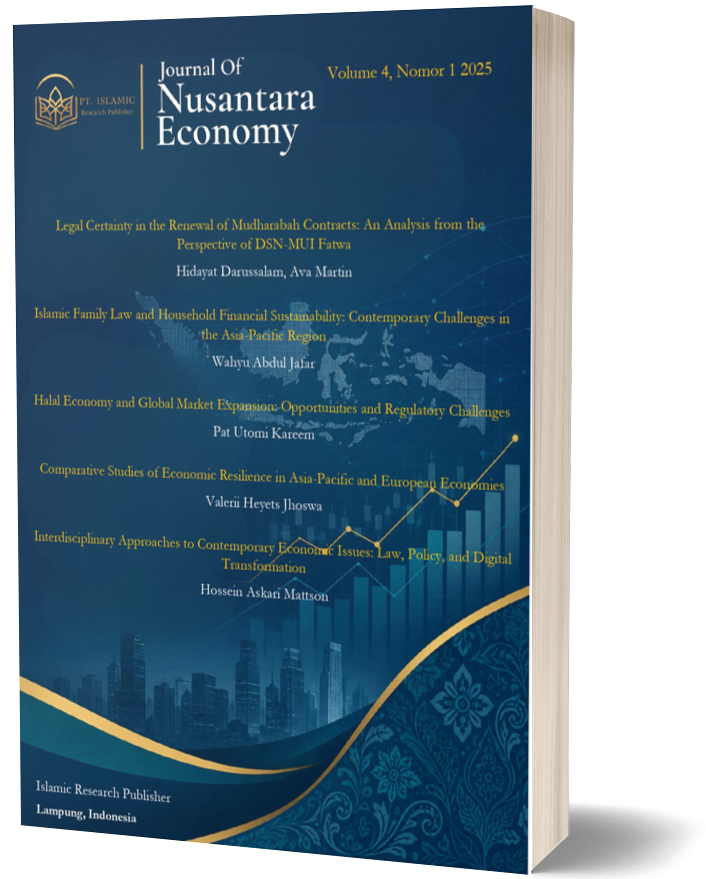
Islamic Family Law and Household Financial Sustainability: Contemporary Challenges in the Asia-Pacific Region
DOI:
https://doi.org/10.66325/nusantaraeconomy.v4i1.254Keywords:
Islamic Family Law; Household Financial Sustainability; Family Welfare; Islamic Economics; Asia-Pacific Region; Maqasid al-Shariah.Abstract
The sustainability of household finances has emerged as a critical issue within contemporary Muslim societies, particularly in the Asia-Pacific region, where rapid economic transformation, digital financialization, changing family structures, and increasing living costs have significantly influenced family welfare. This study aims to examine the relationship between Islamic family law and household financial sustainability by analyzing contemporary challenges faced by Muslim families in the Asia-Pacific context. The research specifically explores how Islamic legal principles governing family rights and obligations, wealth management, maintenance (nafaqah), inheritance, and marital economic responsibilities contribute to the creation of sustainable household financial systems. This study employs a qualitative normative approach based on an extensive literature review of scholarly articles, legal documents, policy reports, and contemporary studies related to Islamic family law and family economics. Data were collected from reputable academic databases and analyzed using a thematic-content analysis framework to identify major patterns, emerging challenges, and legal responses across selected Asia-Pacific countries. The findings reveal that household financial sustainability is increasingly challenged by economic uncertainty, dual-income family dynamics, digital consumerism, rising household debt, gender role transformations, and disparities in financial literacy. The study demonstrates that Islamic family law provides a comprehensive framework for promoting financial resilience through principles of justice, shared responsibility, wealth preservation (hifz al-mal), balanced consumption, and intergenerational economic protection. However, the implementation of these principles often faces institutional, socio-cultural, and regulatory constraints within contemporary societies. The analysis further indicates that integrating Islamic legal values with modern financial governance and family welfare policies can strengthen household economic stability and social well-being. This study contributes to the growing discourse on Islamic family law by connecting classical legal doctrines with contemporary household financial sustainability challenges. It offers a multidisciplinary perspective that enriches discussions on family welfare, Islamic economics, and socio-legal reform, particularly within the diverse and rapidly evolving Asia-Pacific region.
Downloads
References
Abdullah, M., & Rahman, F. (2023). Islamic financial literacy and household economic resilience in Muslim communities. Journal of Islamic Economics and Finance Studies, 9(2), 115–130.
Ahmad, A., & Purwanti, L. (2024). Optimizing family financial stability through Islamic household accounting practices: A literature review. East Asian Journal of Multidisciplinary Research, 3(5), 1721–1732.
An-Na’im, A. A. (2008). Islam and the secular state: Negotiating the future of Shari’a. Harvard University Press.
Arifin, Z. (2022). Household debt and financial vulnerability in Southeast Asia: An Islamic perspective. Islamic Economic Studies, 30(1), 77–95.
Chapra, M. U. (2008). The Islamic vision of development in the light of Maqāṣid al-Sharī‘ah. Islamic Research and Training Institute.
Dewi, N., & Hasan, M. (2023). Digital finance and Muslim household consumption behavior. Journal of Islamic Monetary Economics and Finance, 9(3), 201–220.
Hayati, F. (2024). Konsep nafkah dalam Islam: Kajian literatur terhadap pemahaman klasik dan pendekatan ekonomi syariah modern. Indonesian Journal of Islamic Jurisprudence, Economic and Legal Theory, 2(4), 2946–2957.
Hermanto, R. D., & Subhan, A. (2024). Dekonstruksi konsep nafkah: Analisis systematic literature review terhadap keadilan gender dalam rumah tangga Muslim. Jurnal Antologi Hukum, 5(1), 1–20.
Hassan, M. K. (2021). Islamic finance and sustainable household economics. Journal of King Abdulaziz University: Islamic Economics, 34(2), 45–62.
Hidayat, R., & Yusuf, A. (2023). Maqāṣid al-sharī‘ah and financial inclusion in Muslim societies. Al-Iqtishad: Journal of Islamic Economics, 15(2), 189–208.
Ismail, R., & Abdullah, S. (2022). Financial stress and family well-being in Malaysia. Asian Social Science Review, 14(1), 33–50.
Kaunang, G. C. D., & Husain, S. (2024). Fleksibilitas hukum Islam dalam menjawab tantangan hukum keluarga, HAM dan ekonomi modern: Tinjauan maqashid syariah. Tasyri’: Journal of Islamic Law, 4(2), 101–118.
Kirana, A. A. M., et al. (2024). Islamic household accounting and financial management practices among Muslim families. ISAFIR: Islamic Accounting and Finance Review, 5(1), 45–60.
Kurniawan, T. (2023). Women’s economic participation and transformation of nafkah in Indonesia. Jurnal Hukum Islam Indonesia, 11(2), 98–117.
Mansour, W. (2020). Islamic finance and household welfare: A maqāṣid approach. Islamic Economic Studies, 28(2), 1–25.
Nasohah, Z. (2024). Dynamics of Islamic family law in facing current challenges in Southeast Asia. Samarah: Jurnal Hukum Keluarga dan Hukum Islam, 8(1), 1–25.
Nelli, J. (2017). Analisis tentang kewajiban nafkah keluarga dalam pemberlakuan harta bersama. Al-Istinbath: Jurnal Hukum Islam, 2(1), 29–46.
Nelli, J. (2017). Nafkah as a legal obligation in Islamic family law: Classical and contemporary perspectives. Al-Istinbath: Jurnal Hukum Islam, 2(1), 51–68.
Othman, R., & Owen, L. (2021). Islamic household finance and risk management. Journal of Islamic Accounting Research, 12(3), 77–92.
Putra, A., & Sari, D. (2022). Financial resilience in Muslim families: An empirical study. Journal of Islamic Social Finance, 4(1), 55–73.
Rahman, T. (2023). Maqāṣid al-sharī‘ah and sustainable development in Muslim societies. Journal of Islamic Studies and Culture, 11(2), 112–130.
Rizki, M., & Faridah, N. (2023). Islamic consumer behavior and household spending patterns. Journal of Islamic Marketing, 14(4), 321–339.
Sari, L., & Huda, M. (2022). Digital economy and Muslim household debt behavior. Journal of Islamic Economics Review, 10(1), 44–63.
Setiawan, B. (2021). Islamic inheritance law and intergenerational wealth distribution. Jurnal Hukum dan Syariah, 13(2), 87–104.
Shihab, M. Q. (2012). Tafsir Al-Mishbah: Pesan, kesan dan keserasian Al-Qur’an. Lentera Hati.
Sukardi, A., & Firdaus, M. (2023). Family financial planning in Islamic perspective. Journal of Halal Economics and Management, 6(2), 90–108.
Sulaiman, R. (2022). Islamic family law and economic justice in contemporary society. Islamic Law Review, 18(1), 33–51.
Susanto, E., & Lestari, D. (2023). Financial literacy and household welfare in Indonesia. Journal of Asian Finance, Economics and Business, 10(3), 221–235.
Syahrul, M. (2022). Kafālah keluarga dalam Islam dan perlindungan sosial. Al-Ahkam: Journal of Islamic Law, 32(1), 65–84.
Topal, Ş. (2024). Family, welfare, and economic justice in Islamic legal thought: Revisiting classical jurisprudence in contemporary contexts. Islamic Law and Society, 31(1–2), 1–24.
United Nations Development Programme. (2024). Human development report 2024: Breaking the gridlock—Reimagining cooperation in a polarized world. United Nations Development Programme.
Usman, H. (2023). Islamic financial governance and household stability. Journal of Islamic Economic Governance, 7(2), 101–120.
World Bank. (2023). Global financial development report 2023: Bankers without borders. World Bank.
Yasin, M., & Abdullah, N. (2023). Economic transformation and Muslim family structure in Asia-Pacific region. Journal of Contemporary Islamic Studies, 9(1), 55–74.
Yusuf, Q. (2022). Maqāṣid al-sharī‘ah and modern economic policy. Journal of Islamic Thought and Civilization, 12(2), 145–162.
Zain, A., & Harahap, S. (2023). Household financial management and Islamic ethics. Journal of Islamic Finance and Business Research, 5(3), 88–107.
Zulkifli, M. (2021). Islamic social protection system and family welfare. International Journal of Islamic Economics and Finance, 3(2), 119–138.
Downloads
Published
Issue
Section
License
Copyright (c) 2025 Wahyu Abdul Jafar

This work is licensed under a Creative Commons Attribution-ShareAlike 4.0 International License.