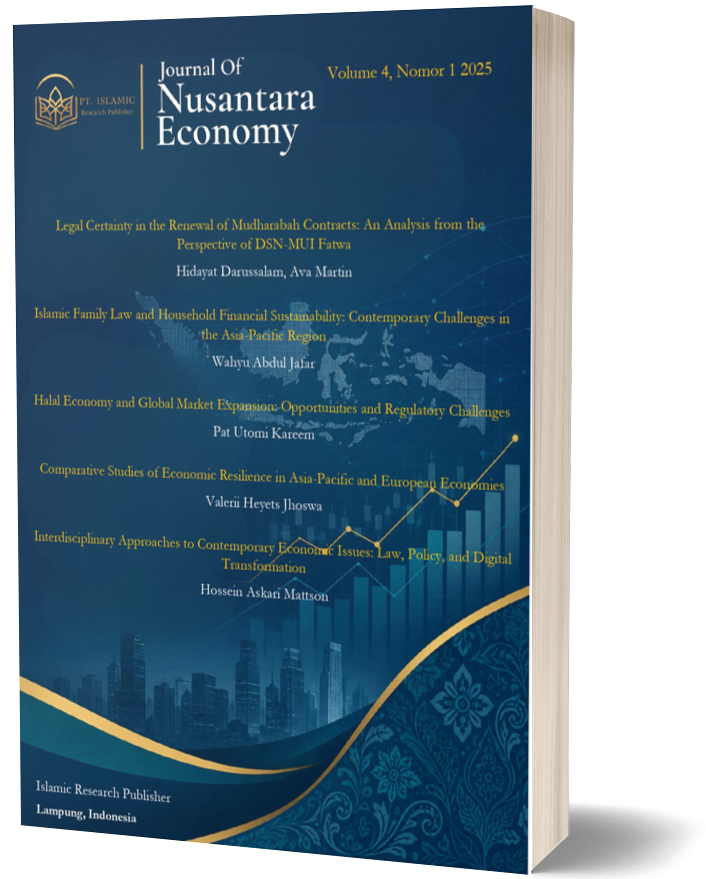
Halal Economy and Global Market Expansion: Opportunities and Regulatory Challenges
DOI:
https://doi.org/10.66325/nusantaraeconomy.v4i1.363Keywords:
Halal Economy; Global Market Expansion; Regulatory Harmonization; Halal Certification; International Trade Governance.Abstract
This study examines the dynamics of the halal economy in the context of global market expansion, focusing on opportunities and regulatory challenges that shape its international development. It aims to analyze how halal economic practices interact with diverse regulatory systems across countries and how these interactions influence market access and competitiveness. The study employs a qualitative doctrinal and conceptual approach based on analysis of regulatory frameworks, policy documents, and relevant scholarly literature. Findings indicate that the halal economy demonstrates strong growth potential driven by rising demand for ethical consumption and expanding global trade networks. However, persistent regulatory fragmentation, inconsistent certification standards, and limited mutual recognition among authorities hinder full market integration. This study contributes by proposing an integrative governance framework for strengthening international coordination, harmonizing standards, and enhancing digital halal certification systems. It also highlights the strategic role of the halal economy as a driver of inclusive and sustainable global economic development in contemporary markets while emphasizing policy alignment between governments, industry actors, and certification bodies to improve transparency, trust, and efficiency in cross-border trade and supply chains worldwide. Overall, the halal economy is positioned as a strategic sector in the evolving global economic architecture, offering significant opportunities for sustainable development, ethical trade expansion, and inclusive growth, particularly for emerging markets and small and medium enterprises seeking access to international value chains, while simultaneously requiring stronger institutional cooperation, regulatory convergence, and technological innovation in certification systems to reduce barriers, enhance compliance efficiency, and strengthen consumer confidence across diverse jurisdictions in an increasingly interconnected and competitive global marketplace over the world.
Downloads
References
Ab Talib, M. S., Hamid, A. B. A., & Chin, T. A. (2016). Can halal certification influence logistics performance? Journal of Islamic Marketing, 7(4), 461–475.
Abdul Latif, V., Mohamed, Z., Sharifuddin, J., Abdullah, A. M., & Ismail, M. M. (2014). A comparative analysis of global halal certification requirements. Journal of Food Products Marketing, 20(S1), 85–101.
Akim, A., Konety, N., Purnama, C., & Adilla, M. H. (2019). The shifting of halal certification system in Indonesia: From society-centric to state-centric. MIMBAR: Jurnal Sosial dan Pembangunan, 35(1), 115–126.
Ali, M. H., Tan, K. H., Ismail, M. D., & others. (2021). Halal supply chain integrity: From a literature review to a conceptual framework. Journal of Islamic Marketing, 12(8), 1505–1527.
Ali, M. H., Tan, K. H., Pawar, K., & Makhbul, Z. K. M. (2017). Securing halal integrity throughout the supply chain. Industrial Management & Data Systems, 117(8), 1527–1547.
Azam, A., & Abdullah, M. A. (2020). Global halal industry: Realities and opportunities. Journal of Islamic Marketing, 11(6), 1737–1753.
Aziz, N. A., Rahman, M. K., & Abdullah, R. (2024). Integrating ESG principles into halal governance for sustainable development. Sustainability, 16(4), 2157.
Casino, F., Dasaklis, T. K., & Patsakis, C. (2019). A systematic literature review of blockchain-based applications: Current status, classification and open issues. Telematics and Informatics, 36, 55–81.
Dwivedi, Y. K., Hughes, L., Baabdullah, A. M., et al. (2023). Artificial intelligence (AI): Multidisciplinary perspectives on emerging challenges, opportunities, and agenda for research, practice and policy. International Journal of Information Management, 70, 102643.
Elasrag, H. (2022). Global halal industry: Trends and prospects. Munich Personal RePEc Archive.
Haleem, A., Khan, S., Khan, M. I., & Khan, S. (2020). Halal certification, the inadequacy of its adoption, modelling and strategizing the efforts. Journal of Islamic Marketing, 11(2), 384–404.
Hanaysha, J. R. (2022). Impact of social media marketing features on consumer's purchase decision in the fast-food industry. Journal of Innovation & Knowledge, 7(1), 100156.
Hassan, R., Abdullah, N., & Ismail, F. (2024). Digital governance and sustainable halal ecosystem: Emerging trends and future directions. Journal of Islamic Marketing.
Islam, T., Islam, R., Pitafi, A. H., Xiaobei, L., Rehmani, M., Irfan, M., & Mubarak, M. S. (2021). The impact of corporate social responsibility on customer loyalty: The mediating role of corporate reputation, customer satisfaction, and trust. Sustainable Production and Consumption, 25, 123–135.
Javaid, M., Haleem, A., Singh, R. P., Suman, R., & Rab, S. (2023). Blockchain technology applications for improving food supply chains and traceability. Sustainable Operations and Computers, 4, 146–158.
Khan, S., Rahman, M. K., & Ali, M. H. (2023). Digital transformation in halal supply chain management: A systematic literature review. Journal of Islamic Marketing.
Khan, S., Khan, M. I., & Haleem, A. (2022). Blockchain technology for halal supply chains: Opportunities and implementation challenges. Computers & Industrial Engineering, 169, 108232.
Khan, S., & Alourani, A. (2024). Artificial intelligence and halal governance: Emerging applications in global supply chains. Journal of Islamic Marketing.
Lever, J., & Miele, M. (2012). The growth of halal meat markets in Europe: An exploration of the supply side theory of religion. Religion, 42(3), 451–469.
Marzuki, S. Z. S., Hall, C. M., & Ballantine, P. W. (2012). Restaurant managers' perspectives on halal certification. Journal of Islamic Marketing, 3(1), 47–58.
Mohd Ali, M. H., Tan, K. H., Pawar, K., & Makhbul, Z. (2018). Maintaining halal integrity in logistics operations. Benchmarking: An International Journal, 25(8), 2993–3015.
Mukhtar, A., & Butt, M. M. (2012). Intention to choose halal products: The role of religiosity. Journal of Islamic Marketing, 3(2), 108–120.
Noordin, N., Noor, N. L. M., Hashim, M., & Samicho, Z. (2014). Strategic approach to halal certification system. Procedia - Social and Behavioral Sciences, 121, 79–95.
Rahman, M. K., et al. (2022). Digital halal certification and SME competitiveness in global markets. Journal of Islamic Marketing.
Razak, N. A., et al. (2023). Halal governance, ESG, and sustainable development: A systematic review. Sustainability, 15(18), 13478.
Soon, J. M., Chandia, M., & Regenstein, J. M. (2017). Halal integrity in the food supply chain. British Food Journal, 119(1), 39–51.
Tieman, M. (2011). The application of halal in supply chain management. Journal of Islamic Marketing, 2(2), 186–195.
Tieman, M. (2013). Establishing the principles in halal logistics. Journal of Emerging Economies and Islamic Research, 1(1), 1–13.
Tieman, M. (2015). Halal clusters and halal supply chain management. Journal of Islamic Marketing, 6(1), 2–21.
Tieman, M., & Darun, M. R. (2017). Leveraging the halal industry through halal logistics. Journal of Islamic Marketing, 8(3), 457–480.
Tieman, M., & Ghazali, M. C. (2014). Halal control activities and assurance activities in halal food logistics. Procedia - Social and Behavioral Sciences, 121, 44–57.
Thomson Reuters, & DinarStandard. (2023). State of the Global Islamic Economy Report 2023/24.
Wilson, J. A. J., & Liu, J. (2010). Shaping the halal into a brand? Journal of Islamic Marketing, 1(2), 107–123.
Wilson, J. A. J., & Liu, J. (2011). The challenges of Islamic branding: Navigating emotions and halal. Journal of Islamic Marketing, 2(1), 28–42.
Yusof, S. M., & Jusoh, W. J. W. (2014). Halal food supply chain knowledge and purchase intention. International Journal of Supply Chain Management, 3(3), 1–7.
Zailani, S., Ali, M. H., Iranmanesh, M., Moghavvemi, S., & Musa, G. (2016). Predicting Muslim medical tourists' satisfaction with Malaysian Islamic-friendly hospitals. Tourism Management, 57, 159–167.
Zailani, S., Iranmanesh, M., Aziz, A. A., & Kanapathy, K. (2020). Halal logistics opportunities and challenges in global trade. Journal of Islamic Marketing.
Zainuddin, N., & Saifudin, A. M. (2019). Halal certification and consumer trust in ASEAN markets. International Journal of Business and Society, 20(3), 1085–1101.
Zulfakar, M. H., Chan, C., & Jie, F. (2018). Institutional forces on Australian halal meat supply chain. British Food Journal, 120(1), 104–120.
Borzooei, M., & Asgari, M. (2013). The halal brand personality and its effect on purchase intention. Interdisciplinary Journal of Contemporary Research in Business, 5(3), 481–491.
Bonne, K., Vermeir, I., Bergeaud-Blackler, F., & Verbeke, W. (2007). Determinants of halal meat consumption in France. British Food Journal, 109(5), 367–386.
Fuseini, A., & Knowles, T. G. (2020). The halal food market: Challenges and future perspectives. Foods, 9(1), 47.
Vanany, I., Soon, J. M., Maryani, A., & Wibawa, B. M. (2020). Determinants of halal-food consumption in Indonesia. Journal of Islamic Marketing, 11(2), 507–521.
Yener, D. (2015). Factors influencing halal certified food purchasing decisions. Journal of Food Products Marketing, 21(2), 160–178.
Zakaria, Z. (2008). Tapping into the world halal market: Some discussions on Malaysian laws and standards. Shariah Journal, 16(3), 603–616.
Downloads
Published
Issue
Section
License
Copyright (c) 2025 Pat Utomi Kareem

This work is licensed under a Creative Commons Attribution-ShareAlike 4.0 International License.