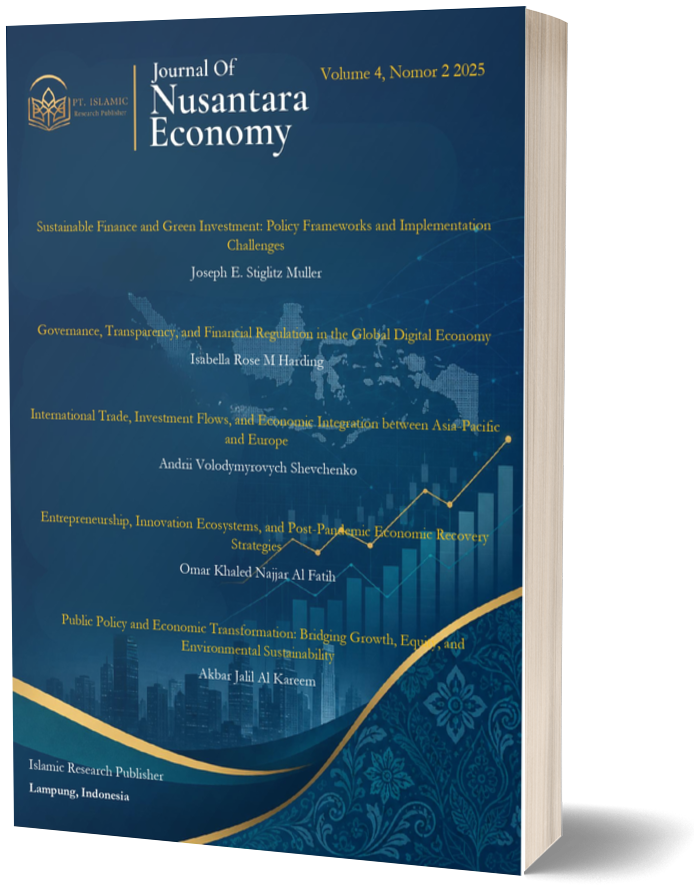
Governance, Transparency, and Financial Regulation in the Global Digital Economy
DOI:
https://doi.org/10.66325/nusantaraeconomy.v4i2.368Keywords:
Digital Economy; Financial Regulation; Governance; Regulatory Transparency; Sustainable Finance.Abstract
The rapid expansion of the global digital economy has fundamentally transformed financial transactions, business models, and cross-border economic interactions, while simultaneously creating complex governance and regulatory challenges. This study aims to examine how governance quality, transparency mechanisms, and financial regulation interact to promote accountability, market integrity, and sustainable growth within the global digital economy. Employing a qualitative field research design, the study collected primary data through semi-structured interviews with financial regulators, fintech practitioners, digital entrepreneurs, and policy experts, complemented by direct observations and analysis of institutional documents and regulatory frameworks. The collected data were analyzed using thematic analysis involving data reduction, categorization, interpretation, and cross-source triangulation to ensure the credibility and validity of the findings. The results demonstrate that effective governance in the digital financial ecosystem depends on the integration of transparent regulatory institutions, adaptive legal frameworks, technological innovation, and collaborative stakeholder engagement. Regulatory fragmentation, inconsistent transparency standards, data privacy concerns, and the rapid evolution of financial technologies remain significant barriers to achieving regulatory effectiveness across jurisdictions. Furthermore, the findings reveal that digital governance mechanisms supported by regulatory technology, real-time monitoring systems, and international regulatory cooperation substantially improve public trust, reduce compliance risks, and strengthen financial resilience in increasingly interconnected markets. The study also highlights that governance effectiveness is influenced not only by formal legal institutions but also by organizational accountability, ethical digital practices, and institutional capacity to respond to technological disruption. This research contributes to the literature by providing an empirically grounded framework that integrates governance, transparency, and financial regulation within the context of the global digital economy. The findings offer practical policy recommendations for governments, regulatory authorities, and international organizations seeking to establish adaptive, transparent, and resilient digital financial governance capable of supporting sustainable economic development.
Downloads
References
Altman, S. A., Baldwin, R., & Freeman, R. (2024). Global supply chains and the restructuring of international trade in the post-pandemic era. Journal of International Economics, 132(2), 1–18.
Baldwin, R. (2023). The new globalization: Reconfiguration of world trade. World Economy, 46(4), 1123–1145.
Baldwin, R., & Freeman, R. (2022). Risks and global supply chains: What we know and what we need to know. Annual Review of Economics, 14(1), 153–180.
Baldwin, R., & Evenett, S. J. (2023). Global trade disruption and policy responses. CEPR Press.
Beckmann, J., & Schmerer, H.-J. (2023). Real and financial integration in Asia. Open Economies Review, 34, 471–478.
Béland, D., & Stanley, J. (2022). Trade policy and geopolitical competition. Review of International Political Economy, 29(6), 1801–1822.
Dorakh, A. (2026). FDI, trade interdependence, and functional integration: The role of EU membership and Asian investment. National Accounting Review, 8(1), 116–149.
Dua, P., & Verma, N. (2023). Drivers of foreign direct investment inflows to emerging Asian economies. South Asian Journal of Macroeconomics, 23(1), 1–25.
Egger, P., Pirotte, A., & Titi, C. (2023). International investment agreements and foreign direct investment: A survey. The World Economy, 46, 1524–1565.
Evenett, S. J. (2022). What endgame for the deglobalisation narrative? Intereconomics, 57(6), 345–351.
Evenett, S. J., & Fritz, J. (2023). Global trade alert report: Protectionism and industrial policy trends. Global Trade Alert.
Faruq, A. O. (2023). The determinants of foreign direct investment in emerging Asian economies. arXiv Preprint.
Fuchs, A., & Klann, N. (2021). Trade openness and economic growth revisited. World Development, 147, 105601.
Gereffi, G. (2022). Global value chains and development: Redefining trade and production. Cambridge Journal of Regions, Economy and Society, 15(3), 411–428.
Görg, H., & Strobl, E. (2021). Foreign direct investment and productivity spillovers. Journal of Development Economics, 149, 102580.
Hausmann, R., & Hidalgo, C. (2021). Economic complexity and trade integration. MIT Press.
International Monetary Fund. (2023). World economic outlook: A rocky recovery.
International Monetary Fund. (2024). Global financial stability report.
Javorcik, B. (2021). Global supply chains and FDI restructuring. World Bank Research Observer, 36(2), 95–120.
Kim, S., & Lee, H. (2022). Regional trade agreements and economic integration in Asia. Asian Economic Journal, 36(4), 389–410.
Kose, M. A., Ohnsorge, F., & Sugawara, N. (2023). Global trade fragmentation. World Bank Policy Research Working Paper.
Le, A. N. N., Pham, H., & Pham, D. T. N. (2023). Political stability and FDI inflows in Asia-Pacific countries. Humanities and Social Sciences Communications, 10(606).
Navarro Zapata, J., García, M., & Liu, Y. (2023). Technological intensity and EU–ASEAN trade. Journal of International Trade Policy, 18(3), 45–67.
Organisation for Economic Co-operation and Development. (2022). OECD investment policy review: Sustainable investment and global value chains.
Organisation for Economic Co-operation and Development. (2023). Economic policy reforms: Going for growth.
Organisation for Economic Co-operation and Development. (2024). FDI regulatory restrictions index report.
Rodrik, D. (2021). Why does globalization fuel populism? Annual Review of Economics, 13, 133–170.
Rodrik, D. (2023). The new global economic order. Project Syndicate Essays.
Sada, S., & Ikeda, Y. (2021). Regional economic integration via detection of circular flow in international value-added network. arXiv Preprint.
Smeets, M. (2022). Trade agreements and investment flows. World Trade Review, 21(3), 345–362.
United Nations Conference on Trade and Development. (2022). World investment report 2022: International tax reforms.
United Nations Conference on Trade and Development. (2023). World investment report 2023: Sustainable investment transitions.
United Nations Conference on Trade and Development. (2024). Global trade update.
United Nations Conference on Trade and Development. (2025). Digital economy and trade development report.
World Bank. (2023). Global economic prospects.
World Bank. (2024). World development report: Trade for development.
World Economic Forum. (2023). Re-globalization and economic resilience report.
World Economic Forum. (2024). Future of global trade and investment.
Zahoor, N., Khan, H., & Khan, Z. (2023). De-globalization and global value chain reconfiguration. Management International Review, 63, 823–859.
Zhang, W., & Wang, Y. (2022). Trade openness and economic integration in Asia. Journal of Asian Economics, 80, 101–115.
Downloads
Published
Issue
Section
License
Copyright (c) 2025 Isabella Rose M Harding

This work is licensed under a Creative Commons Attribution-ShareAlike 4.0 International License.