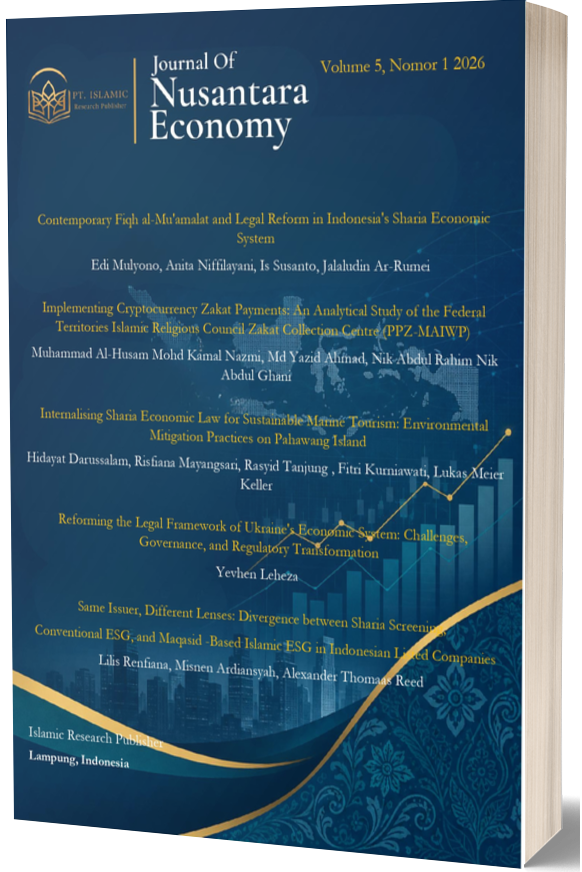
Contemporary Fiqh al-Mu'amalat and Legal Reform in Indonesia's Sharia Economic System
DOI:
https://doi.org/10.66325/nusantaraeconomy.v5i1.387Keywords:
Contemporary Fiqh al-Mu'amalat, Legal Reform, Sharia Economic System, Indonesia, Maqasid al-Shariah.Abstract
The rapid development of the sharia economy in Indonesia has encouraged the emergence of various contemporary financial transactions that require adaptive legal responses. Classical fiqh al-mu'amalat, while providing fundamental principles for economic activities, often faces challenges in addressing modern financial instruments such as Islamic banking, financial technology, digital transactions, and Islamic capital markets. This study aims to analyze the role of contemporary fiqh al-mu'amalat in the process of legal reform within Indonesia's sharia economic system. Employing a normative juridical approach and qualitative library research methods, this study examines legislation, fatwas of the National Sharia Council-Indonesian Ulema Council (DSN-MUI), and scholarly literature on Islamic economic law. The findings indicate that legal reform in Indonesia's sharia economy has been significantly influenced by contemporary ijtihad and maqasid al-shariah approaches, resulting in more contextual and adaptive regulations. The integration of classical fiqh principles with modern legal needs has contributed to the development of an inclusive and dynamic sharia economic system. This study concludes that contemporary fiqh al-mu'amalat serves as a fundamental basis for legal reform and strengthens the institutional framework of Indonesia's sharia economy
Downloads
References
Abdur-Rauf, I. A., Ali, E. M. T. E., Babatunde, M. A., & Balogun, A. D. (2026). Crowdfunding, blockchain, and smart contracts in Islamic finance: Evaluating compliance with Maqasid al-Shariah. Elicit Journal of Economics and Management Studies, 2(1), 61–83.
Adedeji, O., & Campbell, O. (2013). The role of higher education in human capital development. Available at SSRN 2380878.
Afdawaiza, A., Mas’ud, R., & Manulandong, S. Q. (2024). Islamic Banks in the digital age: balancing innovation with Sharia principles. IKONOMIKA, 33–50.
Al Hasan, F. A. (2019). Peran Pengadilan Agama dalam Mendukung Perkembangan Industri Keuangan Syariah di Indonesia. Al-Ahkam: Jurnal Ilmu Syari’ah Dan Hukum, 4(1).
Alam, N., Gupta, L., & Zameni, A. (2019). Fintech and Islamic finance. Springer.
Azizov, E., Azizov, A., Azizli, A., & Babayev, A. A. (2025). A Maqasid al-Shariah Framework for Fintech and Digital Asset Regulation in Muslim Jurisdictions. Journal of Islamic Law and Legal Studies, 2(2), 96–113.
Benuf, K., & Azhar, M. (2020). Metodologi penelitian hukum sebagai instrumen mengurai permasalahan hukum kontemporer. Gema Keadilan, 7(1), 20–33.
Chairawan, I., Iskandar, I., & Ibrahim, A. (2026). A Critical Evaluation of Islamic Economic Growth in Developing Countries. Share: Jurnal Ekonomi Dan Keuangan Islam, 15(1), 36–54.
Disantara, F. P. (2024). Innovative Legal Approaches for Contemporary Challenges in Indonesia: Pendekatan Hukum Inovatif untuk Tantangan Kontemporer di Indonesia. Indonesian Journal of Innovation Studies, 25(4), 10–21070.
Ercanbrack, J. (2015). The transformation of Islamic law in global financial markets. Cambridge University Press.
Harefa, S. (2025). The fundamental principles of Islamic law in the digital era: An ushul fiqh and maqashid Sharia approach. Journal of Islamic Law on Digital Economy and Business, 84–99.
Islahudin, A. N., Fitriyah, F., & Masduki, M. A. (2025). Living Fatwa: Studi Fatwa DSN-MUI Tentang Jasa Keperantaraan di Indonesia. ADZKIYA: Jurnal Hukum Dan Ekonomi Syariah, 13(2), 1–16.
Isra, S. (2021). Indonesian Law In Transition: Perspectives, Challenges and Prospects of Ongoing Law Reform.
Kader, H. (2021). Human well-being, morality and the economy: an Islamic perspective. Islamic Economic Studies, 28(2), 102–123.
Khalidin, B. (2024). Economic empowerment with Islamic economics-based instruments. American Journal of Humanities and Social Sciences Research, 7(3), 18–27.
Khan, J., & Belk, R. (2025). Digital currency and consumption: the meaning of money in an era of digital currency. Routledge.
Leheza, Y., Kurakin, O., Shapovalova, O., Sokh, K., & Makarov, A. (2026). Interpretation of Regulatory and Legal Acts in Contemporary Contexts: Foreign Experience, Comparative Perspectives, and Pathways for Regulatory Reform. NUSANTARA: Journal Of Law Studies, 5(1), 102–122.
Majid, A. (2025). Analisis Konsep dan Aplikasi Maqashid Syariah Dalam Pengelolaan Keuangan Syariah. Syarikat: Jurnal Rumpun Ekonomi Syariah, 8(2), 442–453.
Musadad, A., Nasik, K., Khazin, A. M., & Syaifudin, M. (2025). The role of the taysir manhaji method in the development of islamic economic law in indonesia through dsn-mui fatwas. Journal of Islamic Economic Laws, 8(01), 130–154.
Octavia, N. A. (2017). Kedudukan Fatwa DSN MUI Sebagai Dasar Hukum Dalam Menyelesaikan Sengketa Ekonomi Syari’ah di Pengadilan Agama. IAIN Metro.
Renie, E. (2021). the Urgency of Fatwa in the Law of Sharia Economics in Indonesia. JURIS (Jurnal Ilmiah Syariah), 20(2), 201–208.
Saeed, A. (2018). Human rights and Islam: An introduction to key debates between Islamic law and international human rights law. Edward Elgar Publishing.
Suaidi, S. (2025). Bridging institutional and regulatory gaps: Enhancing sharia compliance in islamic financial institutions in indonesia. El-Uqud: Jurnal Kajian Hukum Ekonomi Syariah, 3(1), 23–39.
Tahir, R., Astawa, I. G. P., Widjajanto, A., Panggabean, M. L., Rohman, M. M., Dewi, N. P. P., Deliarnoor, N. A., Abas, M., Ayu, R. F., & Meinarni, N. P. S. (2023). Metodologi penelitian bidang hukum: Suatu pendekatan teori dan praktik. PT. Sonpedia Publishing Indonesia.
Zuhdi, A., Saputra, E., Hidayat, H., Umam, K., & Hayamansyah, D. (2025). Towards an Integrated Sharia Governance Model in Indonesia: Legal Pluralism and the Reconfiguration of State Religion Relations in Financial Supervision. Al-Istinbath: Jurnal Hukum Islam, 10(2), 873–899.
Downloads
Published
Issue
Section
License
Copyright (c) 2026 Edi Mulyono, Anita Niffilayani, Is Susanto, Jalaludin Ar-Rumei

This work is licensed under a Creative Commons Attribution-ShareAlike 4.0 International License.