
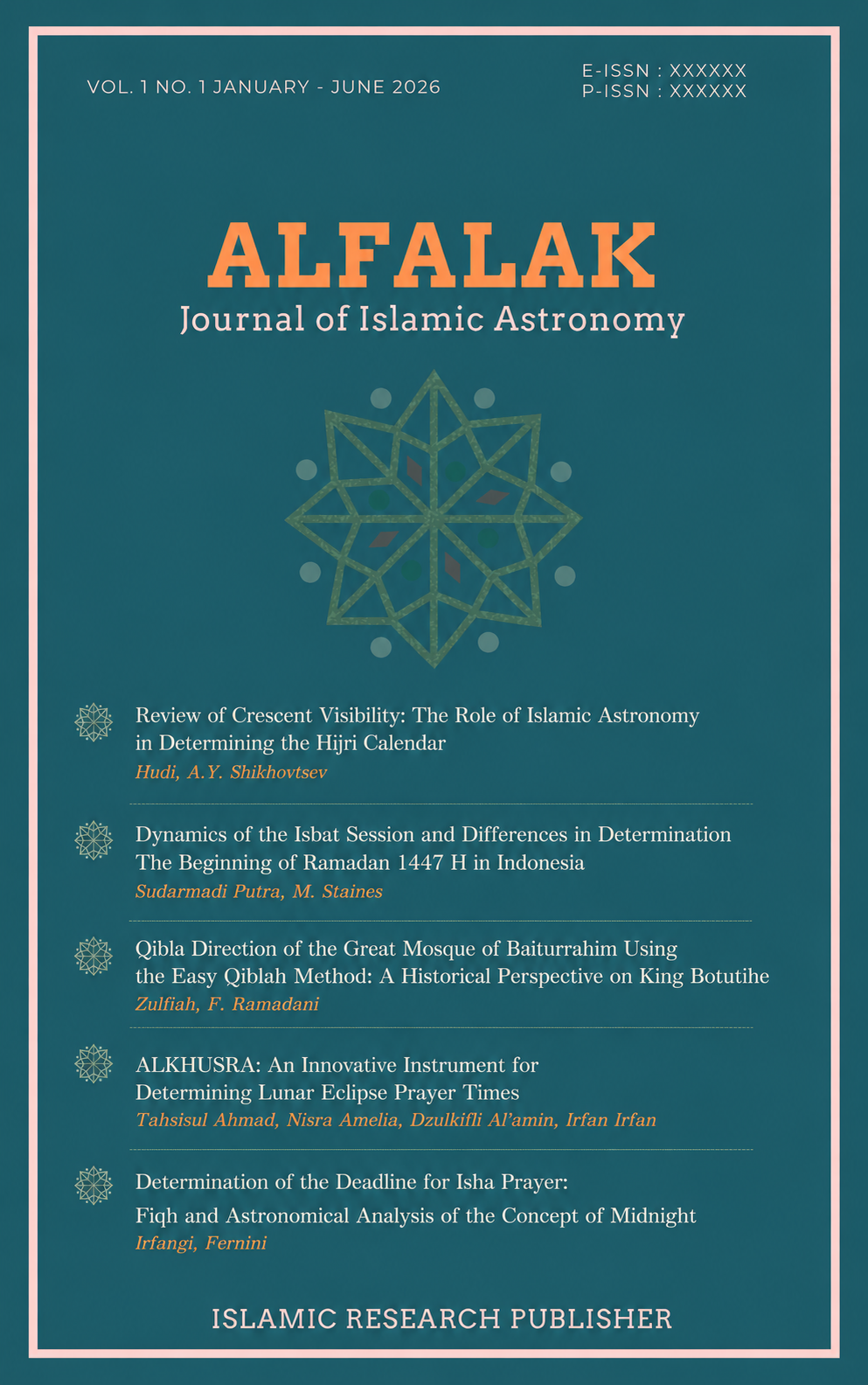
The Dynamics of the Isbat Session and Differences in Determining the Beginning of Ramadan 1447 H in Indonesia
DOI:
https://doi.org/10.66325/kjrknc31Keywords:
Hilal, Hisab, Rukyat, RamadanAbstract
The isbat session is an official mechanism in determining the beginning of the Hijri month in Indonesia that integrates the methods of hisab and rukyat. Differences in the early determination of Ramadan 1447 H among Muslims still often occur due to differences in the visibility criteria of the hilal and the methodological approach used by each group. This study aims to examine the dynamics of the isbat session and analyze the factors that cause the difference in the initial determination of Ramadan 1447 H. This research uses a qualitative approach with a literature study method through a study of the results of the isbat session, hilal astronomy data, and previous research related to hisab and rukyat. The results of the study show that astronomical data provides a strong scientific basis in predicting the possibility of moon visibility, but differences in the criteria used and the results of field observations affect the decisions taken. The integration of hisab and rukyat in the isbat session reflects an attempt to compromise between scientific and normative approaches, although it has not been able to completely eliminate differences in society. This research provides a theoretical contribution to the study of Islamic astronomy and offers a perspective in strengthening a methodology for determining the beginning of the Hijri month that is more integrative and accurate.
References
Atkinson, J. (2016). Academic libraries and research support: An overview. In Quality and the Academic Library: Reviewing, Assessing and Enhancing Service Provision. https://doi.org/10.1016/B978-0-12-802105-7.00013-0
Azhari, S. (2006). Karakteristik Hubungan Muhammadiyah dan NU dalam Menggunakan Hisab dan Rukyat. Al-Jami’ah: Journal of Islamic Studies. https://www.aljamiah.or.id/index.php/AJIS/article/view/63
González-Solar, L., & Fernández-Marcial, V. (2021). Academic Library Research Support Services in the Maker Culture Era. In Examining the Impact of Industry 4.0 on Academic Libraries. https://doi.org/10.1108/978-1-80043-656-520201018
Irwan Muhammad Ridwan. (2020). Harmoni, Disharmoni, dan Integrasi Antara Sains dan Agama. Jurnal Filsafat Indonesia, Query date: 2024-09-15 11:23:26. https://doi.org/https://doi.org/10.23887/jfi.v3i1.22472
Kalu, C. O., Chidi-Kalu, E. I., & Mafe, T. A. (2021). Research data management in an academic library. In Handbook of Research on Information and Records Management in the Fourth Industrial Revolution. https://doi.org/10.4018/978-1-7998-7740-0.ch003
Leech, N. L., & Onwuegbuzie, A. J. (2009). A typology of mixed methods research designs. Quality and Quantity, 43(2). https://doi.org/10.1007/s11135-007-9105-3
Marwadi, M. (2009). Konversi Kalender dari Hijriyah ke Masehi. Al-Manahij: Jurnal Kajian Hukum Islam, 3(1), 37–52. https://doi.org/10.24090/mnh.v3i1.3679
Marwadi, M. (2013). Pembaruan Kriteria Visibilitas Hilal dan Peluangnya terhadap Penyatuan Kalender Hijriyah di Indonesia (Studi Pemikiran LP2IF-RHI). Al-Manahij: Jurnal Kajian Hukum Islam, 7(1), 139–154. https://doi.org/10.24090/mnh.v7i1.583
Rofiuddin, A. A. (2019). Dinamika Sosial Penentuan Awal Bulan Hijriah di Indonesia. Istinbath: Jurnal Hukum Dan Ekonomi Islam, 18(2).
Sakirman. (2011). Menelisik Metodologi Hisab Rukyat di Indonesia. HUNAFA: Jurnal Studia Islamika, 8(2). https://doi.org/10.24239/jsi.v8i2.368.341-362
Sakirman. (2017). Geneologi Ilmu Falak dalam Studi Hukum Islam. Mahkamah : Jurnal Kajian Hukum Islam, 2(1). https://doi.org/10.24235/mahkamah.v2i1.1503
Sakirman. (2022). Visibilitas Hilal Kajian terhadap Problematika Rukyat, Fisis Hilal, dan Cahaya Syafak. CV. Idea Sejahtera.
Sakirman, S. (2016). Islam Aboge dalam Tradisi Jawa Alastua. IBDA: Jurnal Kajian Islam Dan Budaya, 14 (2), 172–187. Query date: 2023-08-24 21:33:18.
Shikhovtsev, A. Y. (2026). Review of Crescent Visibility: The Role of Islamic Astronomy in Determining the Hijri Calendar. Journal of Islamic Astronomy, 1(1), 1–11.
Syarif, M. R., Sakirman, S., & Syarif, M. F. (2025). A Semantic Literature Review on Crescent Visibility: Trends, Models, and Implications for the Islamic Calendar. Al-Hilal: Journal of Islamic Astronomy, 7(1), 67–88. https://journal.walisongo.ac.id/index.php/al-hilal/article/view/26099
Thomas Djamaluddin. (2005). Mengagas Fiqh Astronomi. Kaki Langit.
Utama, J. A., & Simatupang, F. M. (2019). The new hilaal visibility criterion for tropical region. Journal of Physics: Conference Series, 1280(2). https://doi.org/10.1088/1742-6596/1280/2/022073
Downloads
Published
Issue
Section
License
Copyright (c) 2026 ALFALAK: Journal of Islamic Astronomy

This work is licensed under a Creative Commons Attribution-ShareAlike 4.0 International License.


