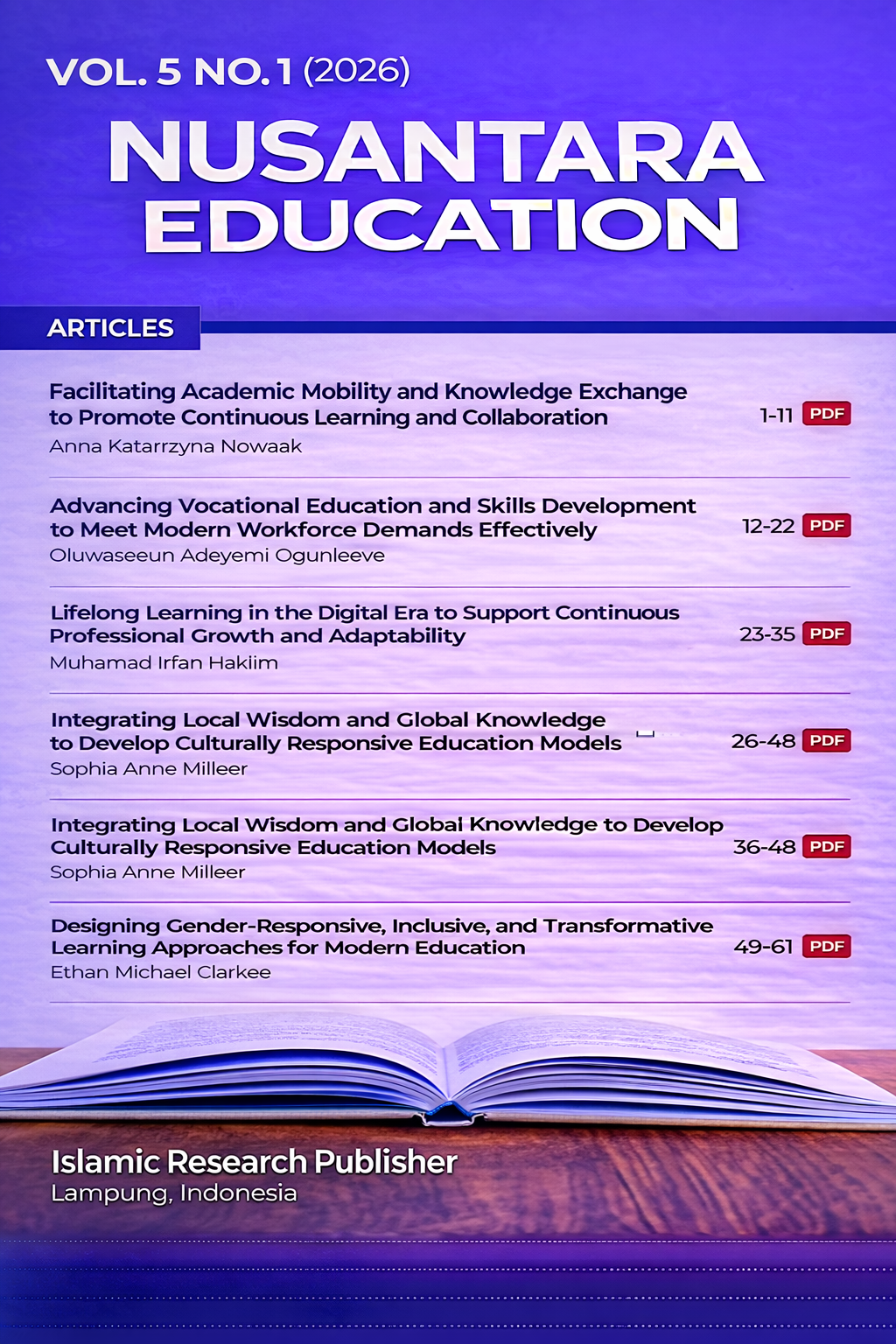
Lifelong Learning in the Digital Era to Support Continuous Professional Growth and Adaptability
DOI:
https://doi.org/10.66325/nusantaraeducation.v5i1.256Keywords:
Adaptability; Continuous Professional Development; Digital Learning; Lifelong Learning; Workforce Skills.Abstract
This study examines the role of lifelong learning in the digital era as a strategic approach to fostering continuous professional growth and adaptability in an increasingly dynamic and technology-driven environment. The primary objective is to analyze how digital-based learning ecosystems contribute to the development of competencies, resilience, and career sustainability among professionals across diverse sectors. This study employs a qualitative field research design to explore digital learning practices, skill development, and adaptive capacity in real-world contexts. Data were collected directly from participants through in-depth interviews, observations, and documentation in selected educational settings. Informants were purposively selected based on their involvement and experience in implementing digital learning. The data were then analyzed using thematic coding to identify key patterns, challenges, and adaptive strategies emerging from the field. The findings reveal that lifelong learning in the digital context is characterized by flexibility, accessibility, and personalization, enabling individuals to continuously update their knowledge and skills in response to rapid technological change. Digital platforms, including online courses, micro-credentials, and collaborative learning environments, play a pivotal role in enhancing both technical and soft skills, such as critical thinking, problem-solving, and digital literacy. Furthermore, integrating self-directed learning with organizational support systems significantly enhances professional adaptability and long-term employability. This study contributes to the existing body of knowledge by offering a comprehensive conceptual framework that links lifelong learning, digital transformation, and workforce adaptability. It also highlights the importance of policy support and institutional innovation in creating inclusive and sustainable learning ecosystems. The findings provide practical implications for educators, policymakers, and organizations in designing strategies that promote continuous learning as a core component of professional development in the digital age.
References
Bailey, R., Booth-Kurpnieks, C., Mateescu, L., Roebuck, J., Whitehead, C., Williams, C., & Tymon, C. (2026). Lifelong Learning on the High Street: Exploring a capabilities approach to place-based cultural development in Kirklees. International Journal of Lifelong Education. https://doi.org/10.1080/02601370.2026.2635701
Cao, M., Wang, A., & Lowry, P. B. (2026). Proposing a Design Theory for a Human-Learning-Guided Virtual Negotiator for Online Trading Platforms. ACM Transactions on Management Information Systems, 17(1). https://doi.org/10.1145/3764663
Cholid, N., Usman, F., Indri, D. B., Kassim, A. H., Masrukhin, N. H. S., Rahmat, & Sholihah, M. (2026). Education Management for Islamic Teacher in the Digital Era: Integrating Innovation and Child Development Needs. Munaddhomah, 7(1), 1–14. https://doi.org/10.31538/munaddhomah.v7i1.2090
Curtis, P., Carey, M. D., McMaster, N., & Martin, D. A. (2026). Advancing digital technology teacher education through the 3C model. Journal of New Approaches in Educational Research, 15(1). https://doi.org/10.1007/s44322-026-00056-1
Guo, D., & Ogbodo, J. N. (2026). Bridging the digital divide: A comparative study of digital literacy and access in rural communities in China and Nigeria. Humanities and Social Sciences Communications, 13(1). https://doi.org/10.1057/s41599-026-06553-0
Hu, L., Rukspollmuang, C., & Viseshsiri, P. (2026). Innovative library management for lifelong learning. IFLA Journal. https://doi.org/10.1177/03400352251412912
Íñiguez-Berrozpe, T., Elboj-Saso, C., Marcaletti, F., & Bautista-Alcaine, P. (2026). Learning to deal with hate speech: An online collective intelligence experiment on the Collective Learning platform. International Journal of Computer-Supported Collaborative Learning, 21(1), 123–154. https://doi.org/10.1007/s11412-025-09460-9
Lang, J., Acquaro, D., Anderson, M., Mandouit, L., Wilson, E., Favero, E., & Marlow, E. (2022). Value of Mentor Professional Learning Through a Digital Micro-Credential in a School-University Partnership. In O. J. Bradbury & D. Acquaro (Eds), School-University Partnerships-Innovation in Initial Teacher Education (pp. 109–128). Springer Nature. https://doi.org/10.1007/978-981-19-5057-5_8
Lim, T. P., & Teh, W. C. (2026). IT mindfulness and AI literacy shape lifelong learning orientation through student engagement and learning agency in AI-enhanced online learning. Discover Education, 5(1). https://doi.org/10.1007/s44217-026-01219-0
Luan, P.-C., Kuo, P.-H., Chen, Y.-C., Chang, C.-W., Feng, P.-H., & Li, T.-H. S. (2026). Advanced biomimetic robotic hand with EMG lifelong learning and recognition. Scientific Reports, 16(1). https://doi.org/10.1038/s41598-025-30658-2
Naufalin, L. R., Indrawati, C. D. S., Indriayu, M., & Noviani, L. (2026). Bridging Religiosity and Digital Competence: The Mediating Role of Digital Ethics in Higher Education. Munaddhomah, 7(1), 92–108. https://doi.org/10.31538/munaddhomah.v7i1.2455
Nopas, D.-S. (2026). Lifelong learning for NEET youth: Policy accessibility and employment pathways in Singapore, South Korea, and Thailand. Studies in the Education of Adults, 58(1), 9–37. https://doi.org/10.1080/02660830.2025.2547437
Nowaak, A. K. (2026). Facilitating Academic Mobility and Knowledge Exchange to Promote Continuous Learning and Collaboration. Nusantara Education, 5(1), 1–12. https://doi.org/10.66325/nusantaraeducation.v5i1.254
Oltean, M.-D., Appiah-Kubi, E., & Baltador, L. A. (2026). Reimagining Education for Growth: Linking Lifelong Learning, Inclusion, and Public Investment to Economic Performance in the European Union. Education Sciences, 16(1). https://doi.org/10.3390/educsci16010027
Osathanunkul, R., Suree, N., Woradit, K., Pirabun, N., Yamaka, W., & Jaipong, P. (2026). Career success and motivation for lifelong learning: A disaggregated analysis of motivational factors. Frontiers in Education, 11. https://doi.org/10.3389/feduc.2026.1647901
Pörzse, G., & Kenesei, Z. (2026). To enrol or not to enrol: What are the risks in choosing a massive open online course (MOOC)? International Review of Education. https://doi.org/10.1007/s11159-025-10170-5
Rababa, M., Al-Za’areer, M. S., Elshatarat, R. A., Al niarat, T. F., Saleh, Z. T., Hamithi, M. A., Alnawafleh, K. A., Alharbi, A. A., Alasmari, A. A., & Ismail, M. S. (2026). Lifelong learning tendencies, counseling self-efficacy, professional self-doubt, and perceptions of nursing excellence among emergency and critical care nurses: A cross-sectional study. Applied Nursing Research, 88. https://doi.org/10.1016/j.apnr.2026.152062
Rakovitis, D. (2026). Lifelong Learning-Based MPC for Uncertain Multi-Task Manipulation. IEEE Robotics and Automation Letters, 11(4), 4977–4984. https://doi.org/10.1109/LRA.2026.3668586
Salwa Rabbi Nishat, T., Barua, S., Uddin Ahmed, M., & Begum, S. (2026). Enhancing Random Forest Using Genetic Algorithm for Lifelong Machine Learning. IEEE Access, 14, 6310–6325. https://doi.org/10.1109/ACCESS.2026.3651601
Samy, D. P. A. (2026). Digital literacy and post truth challenges in the rural academic ecosystem of Tamil Nadu. Discover Education, 5(1). https://doi.org/10.1007/s44217-025-01073-6
Simamora, R. S., Reubun, Y. T. A., Indrawati, L., Putra, T. D., Rahayu, F. E., Khayla, R. P., Agustian, M. L. F., & Zahra, A. (2026). The effect of Ogapudake digital education on mothers knowledge of stunting prevention. Multidisciplinary Reviews, 9(9). https://doi.org/10.31893/multirev.2026429
Singh, D., & Soni, R. (2026). The role of life skills education and grit in adolescent resilience in the digital age. Discover Psychology, 6(1). https://doi.org/10.1007/s44202-026-00605-x
Tripathi, A., Ansari, M. S., & Srivastava, N. A. (2026). Redefining information literacy standards for lifelong learning: A comparative analysis across libraries, disciplines, and global contexts. College and Undergraduate Libraries, 33(1), 1–21. https://doi.org/10.1080/10691316.2025.2576845
Wang, Y., Webster, E., Crolla, M., & Macaden, L. (2026). A human rights-based approach to dignity education in health & social care practice–development and evaluation of a Massive Open Online Course (MOOC). Cogent Education, 13(1). https://doi.org/10.1080/2331186X.2026.2641870
Wu, Y., & Song, X. (2026). Long Short-Term Memory-Based Sentiment Analysis Model for Emotion Recognition in Online English Learning Platforms. Journal of Circuits, Systems and Computers, 35(9). https://doi.org/10.1142/S0218126626500192
Yang, M., Ren, G., Xiao, Y., & Guo, L. (2026). The impact of digital literacy on green consumption behavior under the moderation of prosocial behavior. Scientific Reports, 16(1). https://doi.org/10.1038/s41598-025-34459-5
Yoo, S. J., & Choi, J. (2026). Digital learning engagement and career transitions across age cohorts: Evidence from South Korea’s lifelong education system. International Journal of Lifelong Education. https://doi.org/10.1080/02601370.2026.2638851
Yu, T., Wei, C., Na, M., & Alam, S. S. (2026). Enhancing media literacy to combat information fragmentation in digital short video platforms: A cross-sectional study. Scientific Reports, 16(1). https://doi.org/10.1038/s41598-025-31409-z
Zhou, S., & Li, Q. (2026). Mitigating catastrophic forgetting in lifelong learning: A hybrid architecture integrating neural ordinary differential equations with memory-augmented transformers. Scientific Reports, 16(1). https://doi.org/10.1038/s41598-025-31685-9
Zhu, F., Chen, Z., Tao, W., Lu, Q., Lv, L., Tan, H., & Tao, Z. (2026). Multi-faceted, multi-scale, and multi-task trend learning for denied check-in prediction on online travel platforms. Data Mining and Knowledge Discovery, 40(2). https://doi.org/10.1007/s10618-026-01185-z
Downloads
Published
Issue
Section
License
Copyright (c) 2026 Muhamad Irfan Hakiim

This work is licensed under a Creative Commons Attribution-ShareAlike 4.0 International License.