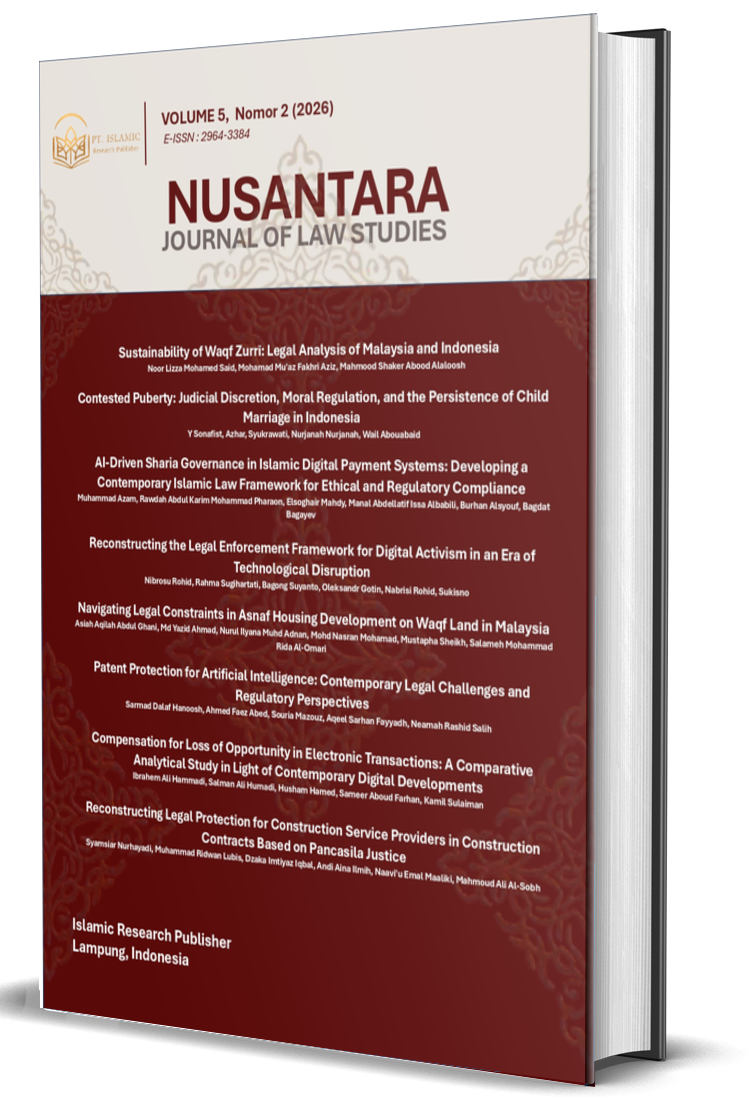
Sustainability of Waqf Zurrī: Legal Analysis of Malaysia and Indonesia
DOI:
https://doi.org/10.66325/nusantaralaw.v5i2.259Keywords:
Comparative Legal Analysis; Indonesia; Malaysia; Sustainability; Waqf Zurrī.Abstract
This study examines the sustainability of waqf zurrī through a statutory analysis of waqf zurrī legislation in Malaysia and Indonesia based on the views of classical jurists. Several Muslim-majority countries, such as Egypt, Tunisia, Libya, and the United Arab Emirates, have restricted and repealed waqf zurrī laws due to social, economic, and administrative factors, despite the absence of explicit Shariah prohibition. The main question is whether the legal frameworks in Malaysia and Indonesia contain sustainability elements capable of preventing the factors that led to the restriction and repeal of waqf zurrī in other Muslim countries. This study employs a qualitative doctrinal legal research design based on document analysis to evaluate sustainability elements within legal frameworks. The analysis focuses on Malaysian state waqf enactments, namely the Wakaf (Perak) Enactment 2015, the Wakaf (Terengganu) Enactment 2016, and the Wakaf (State of Selangor) Enactment 2015, as well as Indonesia’s Law of the Republic of Indonesia Number 41 of 2004 and Government Regulation of the Republic of Indonesia Number 42 of 2006, supported by fiqh analysis of juristic opinions. The findings indicate that sustainability elements within waqf zurrī legislation in Malaysia and Indonesia are reflected in statutory definitions, fundamental concepts of waqf zurrī, and governance mechanisms, including legal provisions, managerial competency, protection of family beneficiaries’ rights, continuity of benefits, protection of mawqūf from Improper Interference, and statutory authority for strengthening waqf zurrī. The study suggests that the statutory implementation of waqf zurrī in Malaysia and Indonesia can serve as a reference for other Muslim countries in ensuring the sustainability of waqf zurrī for the welfare of Muslim communities. This research contributes to contemporary fiqh discourse by discussing the sustainability elements reflected in waqf zurrī legislation in Malaysia and Indonesia based on the integration of Shariah principles and modern legal structures.
Downloads
References
Abdillah Nurul Bahri, Ahmad Furqon, and Ali Murtadho. “Analisis Hukum Tentang Rukun Dan Syarat Wakaf Berbasis Teknologi Digital.” Jurnal Ekonomi Dan Hukum Islam 9, no. 1 (2025): 1–14. https://doi.org/10.35316/istidlal.v9i1.771.
Achmad Habib.A. “Implementasi Wakaf Ahli Di Yayasan Bustanul Athfal.” Universitas Islam Negeri Maulana Malik Ibrahim Malang, 2024. http://etheses.uin-malang.ac.id/id/eprint/62399.
Ahmad Ikhsan. “Tinjauan Undang-Undang Nomor 41 Tahun 2004 Tentang Wakaf Terhadap Keabsahan Pergantian Nadzir Tanpa Persetujuan Ahli Waris (Studi Putusan Nomor 512Pdt.G2022Pa.Kdr).” Thesis, Universitas Islam Negeri Syekh Wasil Kediri, 2025.
Ahmad Sanusi, Sri Wahyu Sakina, Salmy Edawati Yaacob, and Mohd Fairuz Md Salleh. “Wakaf Zurri: Instrumen Pengurusan Harta dalam Pembangunan Tamadun Islam.” Journal of Al-Tamaddun 16, no. 1 (June 2021): 139–152. https://doi.org/10.22452/JAT.vol16no1.10.
Alīsh, Muḥammad. Manḥ Al-Jalīl Sharḥ Mukhtaṣar Khalīl. Beirut: Dār al-Fikr, 1984.
Al-Jurjānī. Al-Taʿrīfāt. Beirut: Dār al-ʿIlmiyyah, 2003.
Al-Khaṭīb al-Shirbīnī. Mughnī Al-Muḥtāj Ilā Maʿrifat Maʿānī Alfāẓ al-Minhāj. Beirut: Dār al-Kutub al-ʿIlmiyyah, 1994.
Al-Khinn, Muṣṭafā, Muṣṭafā al-Bughā, and ʿAlī al-Sharbajī. Al-Fiqh al-Manhajī ʿalā Madhhab al-Imām al-Shāfiʿī. Damascus: Dār al-Qalam, 1992.
Aziz Sulton Bahtiar. “Dari Wakaf Ahli Ke Wakaf Khairi.” Institut Agama Islam Negeri Ponorogo, 2022. https://etheses.iainponorogo.ac.id/20732/1/101180027_Aziz%20Sulton%20Bahtiar_HKI.pdf.
Budiman, Muh Arief. “Keabsahan Dan Pengelolaan Wakaf Ahli (Keluarga).” Jurnal EKOBIS-DA; Jurnal Ekonomi Dan Bisnis 01, no. 02 (2020): 38–51. https://doi.org/doi.org/10.58791/febi.v1i2.289.
Daud, Mohd Zaidi, Mohd Norhusairi Mat Hussin, and Syed Alawi Mahdi Syed Mohamad. “Civilizational Development through Family Waqf: An Analysis from Islamic Historical Perspectives.” Journal of Al-Tamaddun 18, no. 2 (2023): 71–86. https://doi.org/doi.org/10.22452/JAT.vol18no2.6.
Efendi, Mansur. “Pelaksanaan Pasal 43 Undang-Undang Nomor 41 Tahun 2004 Mengenai Pengelolaan Harta Wakaf di Pondok Modern Darussalam Gontor.” Al-Ahkam: Jurnal Ilmu Syari’ah Dan Hukum 4 (2019): 151–161. https://doi.org/doi.org/10.22515/alahkam.v4i2.1961.
Fardisa, Nashita Jeanny. “Tukar Guling Wakaf (Studi Komparasi Pandangan Mazhab Hanafi Dan Peraturan Pemerintah No. 42 Tahun 2006).” Universitas Nahdlatul Ulama Sunan Giri, 2022. https://repository.unugiri.ac.id/id/eprint/1790/.
Febriani, Zheirina Diakh. “Optimalisasi Wakaf Dengan Uang dalam Pengembangan Istana Tahfidzul Qur’an NU PAREPARE.” Institut Agama Islam Negeri Parepare, 2023. https://repository.iainpare.ac.id/id/eprint/6434/1/18.2700.022.pdf.
Government Regulation of the Republic of Indonesia Number 42 of 2006 Concerning the Implementation of Law Number 41 of 2004 on Waqf, 42 of 2006 Government Regulation.
Hovden, Eirik. “Backdating the Criticism and Abolition of Family Waqf: Examples from Zaydī Yemen.” Journal of the Economic and Social History of the Orient 68, nos. 5–6 (November 2025): 708–733. https://doi.org/10.1163/15685209-12341653.
Huda, Miftahul, Aditya Prastian Supriyadi, and Ramadhita. “Productive Waqf Law Reform: A Solution to Support Indonesian Local Economy amid Contemporary Global Recession.” MILRev: Metro Islamic Law Review 4, no. 1 (June 2025): 319–359. https://doi.org/10.32332/milrev.v4i2.10210.
Ku Halim, Ku Hanani, Azizah Othman, and Syarifah Md Yusof. Governance of Wakaf Management in Mosque Institutions: A Study t At-Taqwa Masjid, Pulau Pinang. 5, no. 1 (2023). https://repo.uum.edu.my/id/eprint/32450.
Law of the Republic of Indonesia Number 41 of 2004 on Waqf, 41 of 2004 Law of the Republic of Indonesia.
Makhrus. “Dinamika Kebijakan Negara dalam Pengelolaan Wakaf di Indonesia.” JSSH (Jurnal Sains Sosial dan Humaniora) 2, no. 2 (2018): 209–224. https://doi.org/10.30595/jssh.v2i2.3137.
Marwadi, Marwadi, Eva Mir’atun Niswah, Muhammad Fuad Zain, Ahmad Rezy Meidina, and Muhammad Akmal Kafi. “Traditional Islamic Legal Epistemology in Pesantren’s Practice of Ḥisāb.” Al-Ahkam 35, no. 2 (October 2025): 429–458. https://doi.org/10.21580/ahkam.2025.35.2.27687.
Maskur and Soleh Gunawan. “Unsur Dan Syarat Wakaf Dalam Kajian Para Ulama Dan Undang-Undang Di Indonesia.” TAZKIYA Jurnal Keislaman, Kemasyarakatan & Kebudayaan 19, no. 2 (2018): 81–96.
Mat Johar, Muhammad Hilmi, and Siti Aminah Mat Saad. “The Role Of Waqf In Improving The Economic Status Of Muslims, Especially In The Agricultural Sector In Malaysia.” Jurnal ’Ulwan 9, no. 2 (2024): 296–310.
Maulani, Nina. “Syarat Wakaf Dalam Kajian Fiqih Islam Dan Undang Undang Ri No 41 Tahun 2004 Tentang Wakaf.” Al-Akhbar (Jurnal Ilmiah Keislaman) 8, no. 2 (2022): 79–88.
Mohamad, Muhammad Hisyam, and Nur Syahidah Abdul Jalil. “Zurri Waqf In Malaysia: Syariah Rulings, Implementation Reality, And Future Commercialisation.” Journal of Awqaf, Zakat and Hajj (Jawhar), 2025, 61–80. https://doi.org/10.65404/JAWHAR.302004.
Mohamed Said, Noor Lizza, Muhamad Mu’izz Abdullah, and Adnan Mohamed Yusoff. “Judicial Resolution of Hibah (Gift) over Encumbered Property: An Analysis of the Abdul Hamid Masidullah v. Norehan Abdul Jabbar Case.” Jurnal Ilmiah Mizani: Wacana Hukum, Ekonomi Dan Keagamaan 12, no. 2 (2025): 586–600. https://doi.org/10.29300/mzn.v12i2.8660.
Muhamad Don, Mohd Ali. “Penglibatan Sektor Bukan Kerajaan Di Malaysia, Singapura Dan Indonesia Dalam Mengembangkan Potensi Dana Wakaf Suatu Perbandingan.” Paper presented at ACCON 2012 Academic Conference. 2012. https://ir.uitm.edu.my/id/eprint/48547/1/48547.pdf.
Muhammad Khalil, Muhammad Ainul Hakim, Ab Rahman Muhamad Firdaus, Abdullah Thaidi Hussein Azeemi, and Azman Ab. Rahman. “Pengaplikasian Wakaf Ahli Bertempoh (Muaqqat) Sebagai Mekanisme Memakmurkan Amalan Wakaf Di Malaysia.” 2021, 53–71.
Norzilan, Nur Izzati. “Waqf in Malaysia and Its New Waves in the Twenty-First Century.” Kyoto Bulletin of Islamic Area Studies, 2018, 140–157. https://doi.org/doi.org/10.14989/230454.
Pirmani, Ulfa, Edi Kurniawan, and Najmi. “From the Debate on the Legality of Waqf Al-Ahlī to Its Implementation in Southeast Asia: Indonesia, Malaysia, and Singapore.” International Journal of Law and Society (IJLS) 3, no. 2 (August 2024): 59–76. https://doi.org/10.59683/ijls.v3i2.81.
Rakhmat, Adrianna Syariefur, and Irfan Syauqi Beik. “Pengelolaan Zakat dan Wakaf di Malaysia dan Turki: Studi Komparatif.” ILTIZAM Journal of Shariah Economics Research 6, no. 1 (2022): 48–58. https://doi.org/10.30631/iltizam.v6i1.1077.
Sadique, Muhammad Abdurrahman. “The Socio Legal Significance Of Family Waqf And Its Revival Under State Control.” South East Asia Journal of Contemporary Business, Economics and Law 7, no. 4 (2015): 63–69.
Sadique, Muhammad Abdurrahman, Abdul Haseeb Ansari, Mohsin Hingun, and Aznan Hasan. “Socio-Legal Significance of Family Waqf in Islamic Law: Its Degeneration and Revival.” IIUM Law Journal 24, no. 2 (December 2016): 309–334. https://doi.org/10.31436/iiumlj.v24i2.275.
Sesep Saepul Alam. “Studi Komparatif: Pengelolaan Wakaf Di Indonesia, Malaysia Dan Saudi Arabia.” An Nuqud: Journal of Islamic Economics 2, no. 1 (January 2023): 25–33. https://doi.org/10.51192/annuqud.v2i1.419.
Soib, Mohd Shuzaini, and Jasni Sulong. A Comparative Study Of The Practice Of Zakat Distribution To Asnaf Fi Sabilillah In Selected States In Malaysia. 33, no. 2 (2024). https://al-qanatir.com/aq/article/view/646.
Suraiya, Ratna, and Nashrun Jauhari. “Relevansi Wakaf Ahli dalam Membangun Ketahanan Keluarga.” Tasyri’ : Journal of Islamic Law 1, no. 2 (July 2022): 253–292. https://doi.org/10.53038/tsyr.v1i2.33.
Wakaf (Perak) Enactment 2015, 9 Enactment (2015).
Wakaf (State of Selangor) Enactment 2015, 15 Enactment (2015).
Wakaf (Terengganu) Enactment 2016, 1/2016 Enactment (2017).
Wizārat al-Awqāf wa al-Shuʾūn al-Islāmiyyah. Al-Mawsūʿah al-Fiqhiyyah al-Kuwaitiyyah. Kuwait: Wizārat al-Awqāf wa al-Shuʾūn al-Islāmiyyah, 2006.
Yenni Samri Juliati and Maftah Rizki Addin HRP. “Wakaf dan Dasar Hukum Wakaf.” Jurnal Manajemen Dan Bisnis Ekonomi 2, no. 2 (2024): 63–76. https://doi.org/10.54066/jmbe-itb.v2i2.1431.
Zunaidi, Arif. “Wakaf Keluarga Perspektif UU No. 41 Tahun 2004 dan Maqasid Al-Usrah Jamal Al-Din Atiyyah.” Mahakim: Journal of Islamic Family Law 5, no. 2 (July 2021): 115–133. https://doi.org/10.30762/mahakim.v5i2.137.
Downloads
Published
Issue
Section
License
Copyright (c) 2026 Noor Lizza Mohamed Said, Mohamad Mu'az Fakhri Aziz, Mahmood Shaker Abood Alaloosh

This work is licensed under a Creative Commons Attribution-ShareAlike 4.0 International License.