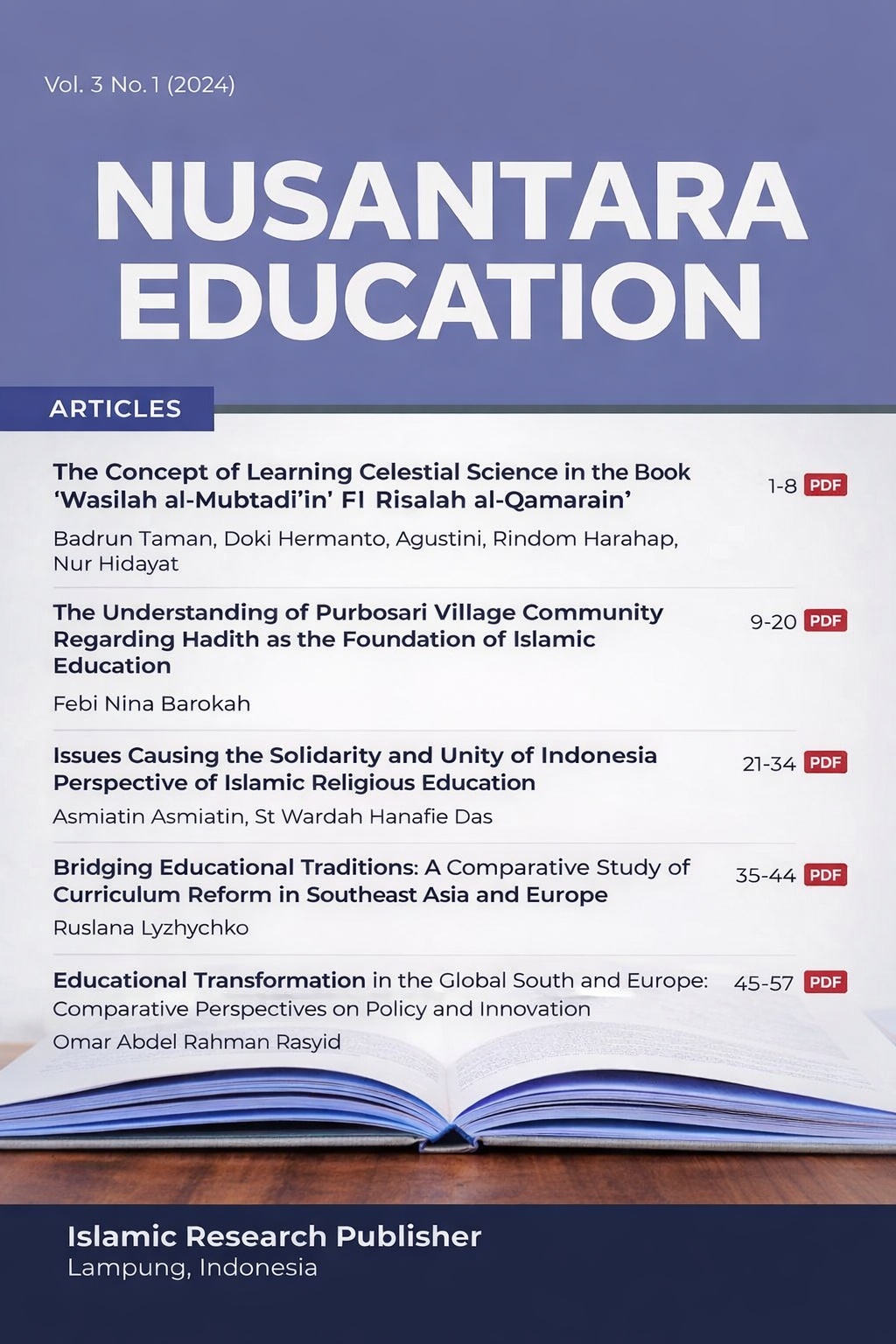
Bridging Educational Traditions: A Comparative Study of Curriculum Reform in Southeast Asia and Europe
DOI:
https://doi.org/10.66325/nusantaraeducation.v3i1.237Keywords:
Comparative education; Curriculum reform; Educational traditionsAbstract
Curriculum reform has become a central agenda in global education systems as countries seek to balance tradition, innovation, and the demands of contemporary society. This study aims to analyze and compare the dynamics of curriculum reform in Southeast Asia and Europe, focusing on how educational traditions are integrated with modern pedagogical approaches. The research seeks to identify key similarities and differences in reform strategies, policy orientations, and implementation frameworks across both regions. This study employs a qualitative comparative research design using a systematic literature analysis and policy document review. Data were collected from academic publications, governmental curriculum frameworks, and international education reports related to curriculum reform in selected Southeast Asian and European countries. The data were analyzed through thematic comparative analysis to identify patterns of reform, institutional drivers, and contextual influences shaping curriculum transformation. The findings reveal that curriculum reform in Southeast Asia tends to emphasize cultural values, national identity, and competency-based learning aligned with socio-economic development goals. In contrast, European curriculum reforms focus more strongly on learner autonomy, interdisciplinary learning, and the integration of digital and critical thinking skills within broader frameworks of educational globalization. Despite these differences, both regions demonstrate a converging trend toward competency-based curricula, inclusive education, and the integration of 21st-century skills. The study also highlights that successful reform initiatives rely heavily on policy coherence, teacher capacity development, and adaptive governance mechanisms. This research contributes to the comparative education literature by providing a cross-regional analytical framework that bridges educational traditions with contemporary curriculum innovation. The study offers insights for policymakers and educators seeking to design contextually responsive curriculum reforms while maintaining global competitiveness and cultural relevance within evolving educational landscapes.
References
Biesta, G. (2015). The beautiful risk of education. London: Routledge.
Biesta, G. (2015). What is education for? On good education, teacher judgement, and educational professionalism. European Journal of Education, 50(1), 75–87
Bowen, G. A. (2009). Document analysis as a qualitative research method. Qualitative Research Journal, 9(2), 27–40.
Creswell, J. W., & Creswell, J. D. (2018). Research design: Qualitative, quantitative, and mixed methods approaches (5th ed.). Thousand Oaks, CA: Sage Publications.
eask, B. (2015). Internationalizing the curriculum: Supporting learners in a globalized world. Journal of Studies in International Education, 19(5), 455–470.
European Commission. (2018). Key competences for lifelong learning: European reference framework. Luxembourg: Publications Office of the European Union.
European Commission. (2018). Key competences for lifelong learning: European reference framework. Luxembourg: Publications Office of the European Union.
Flick, U. (2018). An introduction to qualitative research (6th ed.). London: Sage Publications.
Fullan, M. (2016). The new meaning of educational change (5th ed.). New York: Teachers College Press.
Fullan, M. (2016). The new meaning of educational change and the reform of education systems. Teachers College Record, 118(2), 1–32.
Hallinger, P. (2010). Making education reform happen: Is there an Asian way? School Leadership & Management, 30(5), 401–418.
Hallinger, P. (2010). Making education reform happen: Is there an Asian way? School Leadership & Management, 30(5), 401–418.
Hallinger, P., & Chen, J. (2015). Review of research on educational leadership and management in Asia: A comparative perspective. (1), 5–27.
OECD. (2015). Education policy outlook 2015: Making reforms happen. Paris: OECD Publishing.
OECD. (2018). The future of education and skills: Education 2030. Paris: OECD Publishing.
Patton, M. Q. (2015). Qualitative research & evaluation methods (4th ed.). Thousand Oaks, CA: Sage Publications.
Priestley, M., & Biesta, G. (2013). Reinventing the curriculum. London: Bloomsbury.
Priestley, M., Biesta, G., & Robinson, S. (2015). Teacher agency: An ecological approach. London: Bloomsbury Academic.
Redecker, C. (2017). European framework for the digital competence of educators. Luxembourg: Publications Office of the European Union.
Scott, D. (2014). Education, epistemology and critical realism. London: Routledge.
Tan, C. (2018). Comparative education and curriculum reform in Asia. London: Routledge.
UNESCO. (2019). Education in Southeast Asia: Global challenges and regional responses. Bangkok: UNESCO Asia-Pacific Regional Bureau for Education.
UNESCO. (2019). Education in Southeast Asia: Global challenges and regional responses. Bangkok: UNESCO.
Downloads
Published
Issue
Section
License
Copyright (c) 2024 Ruslana Lyzhychko

This work is licensed under a Creative Commons Attribution-ShareAlike 4.0 International License.