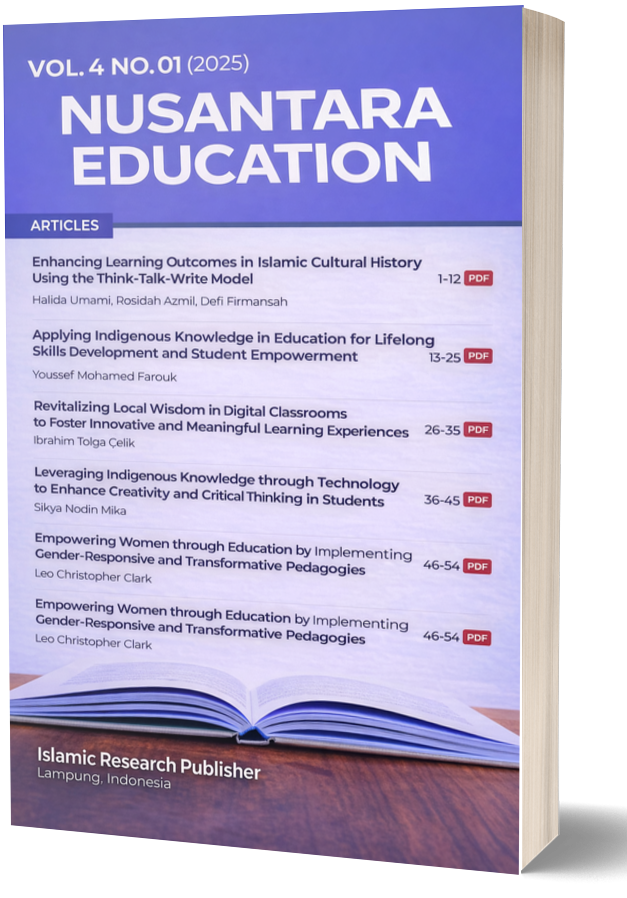
Applying Indigenous Knowledge in Education for Lifelong Skills Development and Student Empowerment
DOI:
https://doi.org/10.66325/nusantaraeducation.v4i1.242Keywords:
Empowerment; Indigenous knowledge; Lifelong learning; Local wisdom; Student-centered learning.Abstract
This study examines the integration of indigenous knowledge into contemporary education as a strategic approach to fostering lifelong skills development and student empowerment. The research aims to analyze how indigenous knowledge is conceptualized and incorporated into modern curricula, identify pedagogical models that effectively support lifelong learning competencies, and evaluate the impact of such integration on students’ agency, critical thinking, and socio-cultural awareness. Addressing the growing need for culturally responsive and contextually relevant education, this study positions indigenous knowledge as a vital epistemological resource rather than a peripheral cultural element. Methodologically, the study employs a qualitative comparative approach, drawing on document analysis, case studies, and a systematic review of scholarly literature across diverse educational contexts, particularly in the Global South and European settings. Data were analyzed using thematic analysis to identify patterns in curriculum design, instructional strategies, and learning outcomes associated with indigenous knowledge integration. The analytical framework is informed by culturally responsive pedagogy and lifelong learning theory. The findings reveal that the integration of indigenous knowledge enhances the development of transferable skills, including critical thinking, problem-solving, collaboration, and adaptive learning. It also strengthens student empowerment by fostering a sense of identity, agency, and community engagement. However, the study identifies several challenges, including limited institutional support, insufficient teacher training, and the marginalization of indigenous epistemologies within standardized curricula. In response, the study proposes a hybrid pedagogical framework that combines contextual learning, participatory approaches, and transformative education principles. This research contributes to the growing body of literature on culturally grounded education by offering a comparative and integrative perspective that bridges traditional knowledge systems with modern pedagogical practices. It provides practical and theoretical insights for policymakers, educators, and curriculum developers seeking to design inclusive and sustainable education systems aligned with global competencies while preserving local cultural identities.
References
Banks, J. A. (2008). An introduction to multicultural education (4th ed.). Pearson.
Battiste, M. (2002). Indigenous knowledge and pedagogy in First Nations education: A literature review with recommendations. Apamuwek Institute.
Battiste, M. (2002). Indigenous knowledge and pedagogy in First Nations education: A literature review with recommendations. Apamuwek Institute.
Bell, S. (2010). Project-based learning for the 21st century: Skills for the future. The Clearing House: A Journal of Educational Strategies, Issues and Ideas, 83(2), 39–43. https://doi.org/10.1080/00098650903505415
Darling-Hammond, L., Flook, L., Cook-Harvey, C., Barron, B., & Osher, D. (2020). Implications for educational practice of the science of learning and development. Educational Researcher, 49(2), 97–108. https://doi.org/10.3102/0013189X20902724
Dei, G. J. S. (2000). Rethinking the role of indigenous knowledges in the academy. International Journal of Inclusive Education, 4(2), 111–132. https://doi.org/10.1080/136031100284849
Dei, G. J. S. (2000). Rethinking the role of indigenous knowledges in the academy. International Journal of Inclusive Education, 4(2), 111–132. https://doi.org/10.1080/136031100284849
Freire, P. (1970). Pedagogy of the oppressed. Continuum.
Gay, G. (2010). Culturally responsive teaching: Theory, research, and practice (2nd ed.). Teachers College Press.
Gay, G. (2010). Culturally responsive teaching: Theory, research, and practice (2nd ed.). Teachers College Press.
Gruenewald, D. A. (2003). The best of both worlds: A critical pedagogy of place. Educational Researcher, 32(4), 3–12. https://doi.org/10.3102/0013189X032004003
Kanu, Y. (2011). Integrating Aboriginal perspectives into the school curriculum: Purposes, possibilities, and challenges. University of Toronto Press.
Kanu, Y. (2011). Integrating Aboriginal perspectives into the school curriculum: Purposes, possibilities, and challenges. University of Toronto Press.
Mezirow, J. (1997). Transformative learning: Theory to practice. New Directions for Adult and Continuing Education, 1997(74), 5–12. https://doi.org/10.1002/ace.7401
Smith, G. A., & Sobel, D. (2010). Place- and community-based education in schools. Routledge. https://doi.org/10.4324/9780203855754
Smith, G. A., & Sobel, D. (2010). Place- and community-based education in schools. Routledge. https://doi.org/10.4324/9780203855754
Smith, L. T. (1999). Decolonizing methodologies: Research and indigenous peoples. Zed Books.
Sterling, S. (2010). Transformative learning and sustainability: Sketching the conceptual ground. Learning and Teaching in Higher Education, 5, 17–33.
UNESCO. (2017). Education for sustainable development goals: Learning objectives. UNESCO Publishing. https://unesdoc.unesco.org/
Vygotsky, L. S. (1978). Mind in society: The development of higher psychological processes. Harvard University Press.
Downloads
Published
Issue
Section
License
Copyright (c) 2025 Youssef Mohamed Farouk

This work is licensed under a Creative Commons Attribution-ShareAlike 4.0 International License.