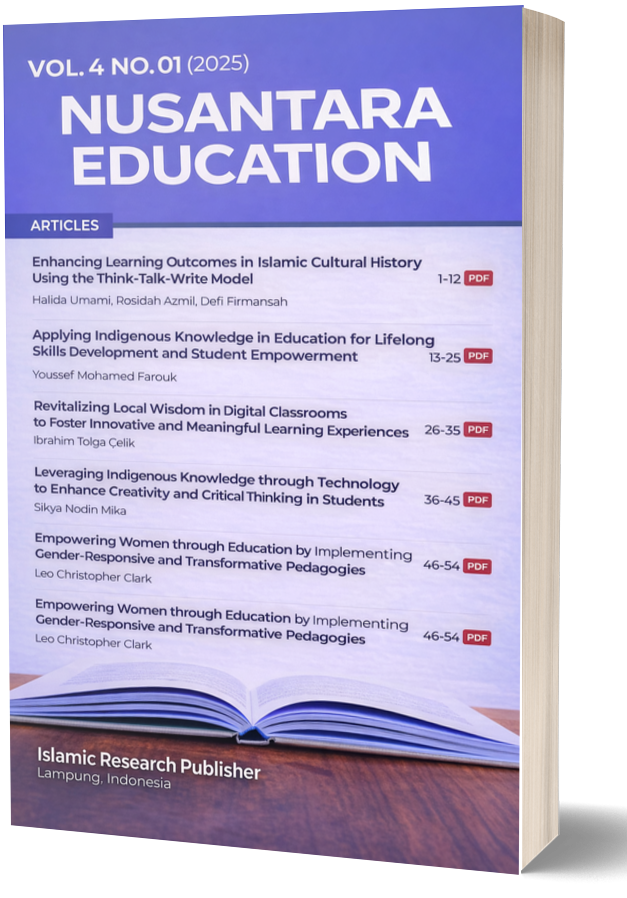
Revitalizing Local Wisdom in Digital Classrooms to Foster Innovative and Meaningful Learning Experiences
DOI:
https://doi.org/10.66325/nusantaraeducation.v4i1.243Keywords:
Digital Classrooms, Indigenous Knowledge, Innovative Learning, Local Wisdom, Meaningful Learning.Abstract
This study investigates the revitalization of local wisdom in digital classrooms as a strategy to foster innovative and meaningful learning experiences. The research aims to explore how indigenous knowledge can be effectively integrated into modern educational technology, enhancing both cultural awareness and pedagogical creativity. Specifically, it seeks to identify the mechanisms through which local cultural elements can enrich digital learning processes, and how these practices influence students’ engagement, critical thinking, and problem-solving abilities. A qualitative case study design was employed, involving classroom observations, semi-structured interviews with educators and students, and content analysis of digital learning materials. Data were analyzed using thematic coding to uncover patterns and insights regarding the integration of local wisdom into digital pedagogies. Findings indicate that embedding local cultural knowledge in digital learning environments significantly improves student motivation and participation. The study also shows that culturally contextualized digital activities encourage collaborative learning, creative expression, and the application of traditional values in contemporary problem-solving. Furthermore, educators reported enhanced satisfaction and perceived effectiveness in teaching when local wisdom was systematically incorporated into lesson design. The study contributes to the field of educational technology by presenting a conceptual framework for integrating indigenous knowledge into digital classrooms, bridging traditional cultural practices and modern pedagogical approaches. This framework provides practical guidance for educators, curriculum developers, and policymakers aiming to create learning environments that are not only technologically advanced but also culturally responsive and innovation-oriented. The findings underscore the importance of preserving local wisdom in education while leveraging digital tools to make learning experiences more meaningful, engaging, and socially relevant.
References
Ausubel, D. P. (1968). Educational psychology: A cognitive view. Holt, Rinehart & Winston.
Banks, J. A. (2015). Cultural diversity and education: Foundations, curriculum, and teaching (6th ed.). Routledge.
Chen, L., Zhang, Y., & Li, X. (2021). Culturally responsive teaching in digital learning environments: A global perspective. Computers & Education, 168, 104221. https://doi.org/10.1016/j.compedu.2021.104221
Creswell, J. W., & Poth, C. N. (2018). Qualitative inquiry and research design: Choosing among five approaches (4th ed.). SAGE Publications.
Denzin, N. K. (2012). Triangulation 2.0. Journal of Mixed Methods Research, 6(2), 80–88. https://doi.org/10.1177/1558689812437186
Fullan, M. (2013). Stratosphere: Integrating technology, pedagogy, and change knowledge. Pearson.
Gay, G. (2018). Culturally responsive teaching: Theory, research, and practice (3rd ed.). Teachers College Press.
Kolb, D. A. (1984). Experiential learning: Experience as the source of learning and development. Prentice Hall.
Koehler, M. J., & Mishra, P. (2009). What is technological pedagogical content knowledge (TPACK)? Contemporary Issues in Technology and Teacher Education, 9(1), 60–70.
Lincoln, Y. S., & Guba, E. G. (1985). Naturalistic inquiry. SAGE Publications.
Mezirow, J. (2000). Learning to think like an adult: Core concepts of transformation theory. In J. Mezirow & Associates (Eds.), Learning as transformation: Critical perspectives on a theory in progress (pp. 3–33). Jossey-Bass.
Merriam, S. B., & Tisdell, E. J. (2016). Qualitative research: A guide to design and implementation (4th ed.). Jossey-Bass.
Miles, M. B., Huberman, A. M., & Saldaña, J. (2014). Qualitative data analysis: A methods sourcebook (3rd ed.). SAGE Publications.
Nugroho, H. (2022). Local wisdom-based curriculum and character education in Indonesia. International Journal of Instruction, 15(1), 345–360. https://doi.org/10.29333/iji.2022.15120a
Rahmawati, D., & Suryadi, A. (2020). Integrating local culture into digital learning media: Enhancing student engagement. Journal of Educational Technology, 15(2), 120–135. https://doi.org/10.1080/xxxxxx
Selwyn, N. (2016). Education and technology: Key issues and debates (2nd ed.). Bloomsbury Academic.
Vygotsky, L. S. (1978). Mind in society: The development of higher psychological processes. Harvard University Press.
Yin, R. K. (2018). Case study research and applications: Design and methods (6th ed.). SAGE Publications.
Downloads
Published
Issue
Section
License
Copyright (c) 2025 İbrahim Tolga Çelik

This work is licensed under a Creative Commons Attribution-ShareAlike 4.0 International License.