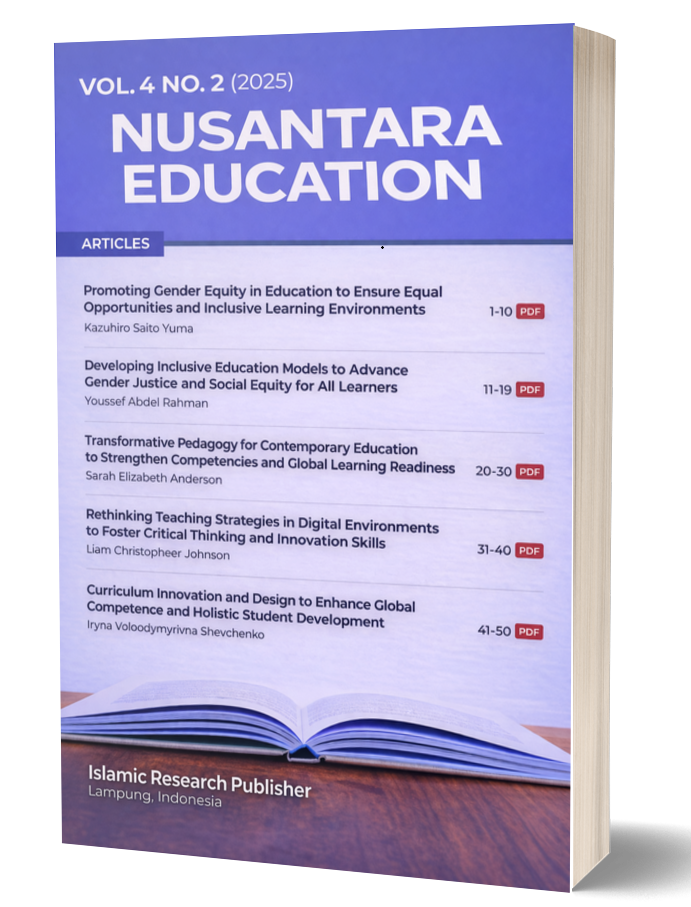
Transformative Pedagogy for Contemporary Education to Strengthen Competencies and Global Learning Readiness
DOI:
https://doi.org/10.66325/nusantaraeducation.v4i2.250Keywords:
Contemporary Education, Global Learning Readiness, Competencies, Higher Education, Educational Innovation.Abstract
The rapid evolution of knowledge, technology, and global interconnectivity has necessitated a paradigm shift in contemporary education. This study explores the implementation of transformative pedagogy to enhance students’ competencies and readiness for global learning environments. The primary objective is to investigate how transformative teaching approaches can foster critical thinking, creativity, collaborative skills, and intercultural awareness among learners, thereby preparing them for complex and dynamic global contexts. This study employs a qualitative field research approach involving 350 students and 45 educators from higher education institutions that implement transformative pedagogy. Data were collected through interviews, observations, and documentation to understand teaching practices and student learning experiences. The data were analyzed thematically to identify patterns in instruction and their impact on competency development and global readiness, with validity strengthened through data triangulation. Findings indicate that transformative pedagogy significantly enhances students’ problem-solving abilities, adaptive learning, and intercultural competencies. Active learning strategies, reflective practices, and collaborative projects emerged as key drivers of enhanced engagement and deep learning. Furthermore, students exposed to these pedagogical approaches demonstrated higher self-efficacy, critical thinking skills, and preparedness for international academic and professional contexts compared to peers in conventional learning environments. The study contributes to the academic discourse on educational innovation by providing empirical evidence that transformative pedagogy is an effective approach to strengthening both cognitive and socio-emotional competencies required for global readiness. Implications for policy and practice suggest that institutions should prioritize curriculum redesign, faculty development, and the integration of experiential and culturally responsive learning models. This research lays the foundation for further studies on scalable, sustainable pedagogical transformations that equip learners to meet the challenges of the 21st century.
References
Afandi, M., Yustiana, S., Rachmadtullah, R., Wahyuningsih, S., & Husain, A. (2025). Innovative Game-Based Digital Media to Improve General Life Skills of Primary School Students: A Development Study in the Context of Education 5.0. Salud, Ciencia y Tecnologia, 5. https://doi.org/10.56294/saludcyt20251967
Agus, A. A., Rizal, A., Muhajir, M., & Jamalong, A. (2025). From awareness to action: Rethinking high school civic education for the digital generation in Indonesia. Cogent Education, 12(1). https://doi.org/10.1080/2331186X.2025.2534156
Albouti, A., & Balaji, K. D. (2025). From Technology Adoption to Digital Transformation How Institutional Trust and Digital Readiness Shape HRIS Success in Higher Education. Journal of Logistics, Informatics and Service Science, 12(10), 110–124. https://doi.org/10.33168/JLISS.2025.1007
Barragán Moreno, S. P., & Lozano Galindo, O. L. (2025a). Modeling digital inequality in basic education: A system dynamics simulation of educational continuity. Frontiers in Education, 10. https://doi.org/10.3389/feduc.2025.1715760
Barragán Moreno, S. P., & Lozano Galindo, O. L. (2025b). Modeling digital inequality in basic education: A system dynamics simulation of educational continuity. Frontiers in Education, 10, 1715760. https://doi.org/10.3389/feduc.2025.1715760
Basri, I. Y., Giatman, M., Mukhaiyar, R., Taali, T., Samala, A. D., & Dewi, I. P. (2025). Digital Education Transformation: Overcoming Existing E-Learning Platform Limitations with Smart Learning Solutions. TEM Journal, 1657–1669. https://doi.org/10.18421/TEM142-63
Benli, G., & Kara, M. (2025). Understanding the pathways to online learner engagement and satisfaction in higher education: The function of digital literacy and dialogue. Journal of Computing in Higher Education. https://doi.org/10.1007/s12528-025-09477-x
Bissette, R. G., Beck, J. H., Novikova, C. O., Lee, Y., Peterman, N. J., Bravo, C. J., & Apel, P. J. (2025). Patient-Directed Care After Carpal Tunnel Release Using Video Integration and Digital Education After Operations (VIDEO Trial): A Randomized Controlled Trial. HAND, 15589447251389650. https://doi.org/10.1177/15589447251389650
Campos-Ortuño, R. A., Lucas, J. M., Franco, D. C., Ruiz, Á. B., & Villar, L. B. E. (2025). The Delphi Method for Integrating Digital Technology and Nature-Based Learning in Primary Education. In Lecture Notes in Educational Technology: Part F642 (pp. 892–901). Springer Science and Business Media Deutschland GmbH. https://doi.org/10.1007/978-981-96-5658-5_88
Çelik, İ. T. (2025). Revitalizing Local Wisdom in Digital Classrooms to Foster Innovative and Meaningful Learning Experiences. Nusantara Education, 4(01), 26–35. https://doi.org/10.66325/nusantaraeducation.v4i1.243
Chan, A. Y. W., & Sung, C. C. M. (2025). Working on a digital research-based collaborative project in higher education: Students’ perspectives on benefits and challenges. Interactive Learning Environments, 33(8), 4718–4735. https://doi.org/10.1080/10494820.2025.2471894
Dzogovic, S. A., Zdravkovska-Adamova, B., & Ramcilovic, Z. (2025). The Role of Higher Education in Promoting Media Literacy in the Age of Digital Disinformation. Human Research in Rehabilitation, 15(2), 311–330. https://doi.org/10.21554/hrr.092506
Fartitchou, M., Lamaakal, I., Makkaoui, K. E., Allali, Z. E., & Maleh, Y. (2025). BlockMEDC: Blockchain Smart Contracts System for Securing Moroccan Higher Education Digital Certificates. IEEE Access, 13, 39152–39175. https://doi.org/10.1109/ACCESS.2025.3546177
Fjeldheim, S., Kleppe, L. C., Stang, E., & Støren-Vaczy, B. (2025). Digital competence in social work education: Readiness for practice. Social Work Education, 44(3), 600–616. https://doi.org/10.1080/02615479.2024.2334800
Gao, Y. (2025). Digital Divide in Spanish Education: A Case Study of AI+Blockchain in Latin American Universities. Journal of Cases on Information Technology, 27(1). https://doi.org/10.4018/JCIT.387080
Guichon, N., Bédard, V., & Fortier, V. (2025). Digital literacy practices outside language classrooms: Insights of adult migrants’ language education. Computer Assisted Language Learning. https://doi.org/10.1080/09588221.2025.2482151
Hennig, S., Vogler, R., Schötz, T., Steinbacher, E.-M., Öttl, U.-F., & Jagust, M. R. (2025). Potential of Learning Labs to Improve the use of Digital Geomedia in Education. The Use Case iDEAS: Lab Discussed using the Example of the ESDplus Project. Acta Polytechnica Hungarica, 22(8), 9–30. https://doi.org/10.12700/APH.22.8.2025.8.2
Hsu, M.-S., Yeh, C.-L., Cheng, S.-J., & Lin, C.-P. (2025). Integrating digital technologies in dental technician education: A comparative study of national examination in Asian countries. Journal of Dental Sciences, 20(1), 28–35. https://doi.org/10.1016/j.jds.2024.10.017
Hu, L., Gong, Y., & Zhu, L. (2025). The impact of new digital infrastructure on total factor productivity in the education service industry: Evidence from China. National Accounting Review, 7(3), 309–339. https://doi.org/10.3934/NAR.2025014
Huang, W., Fook, F. S., & Ibrahim, I. S. B. (2025). Global and China’s Perspectives on Digital Literacy Education: A Comparative CiteSpace Analysis. Asia Pacific Journal of Educators and Education, 40(3), 53–87. https://doi.org/10.21315/apjee2025.40.3.3
Ikwen, E. U., Unimuke, F. A., Eke, V. U., Ataben, M. O., Odey, M. O., Ibok, E. E., Anam, B. B., Igba, I. U., Olofu, P. A., Ogar-Ikwen, T. A., Okoi, I. I., Udie, L. I., & Undie, J. B. (2025). Innovative Digital Tools for Enhancing Phonemic Awareness among Learners with Mild Cognitive Impairment in Calabar Education Zone of Cross River State, Nigeria. Journal of Intellectual Disability - Diagnosis and Treatment, 13(2), 152–159. https://doi.org/10.6000/2292-2598.2025.13.02.4
Imran, K., Devaputra, G., Kaisar, M., & K. B, V. (2025). Managing the digital revolution in higher education: Recognizing obstacles, possibilities, and techniques to improve faculty work/life balance and institutional sturdiness. Journal of Workplace Behavioral Health. https://doi.org/10.1080/15555240.2025.2541863
Jain, C., Rathore, P., Sathiyanarayanan, M., Prasad, M., & Rose, C. (2025). Harnessing Artificial Intelligence and Digital Transformation for Industry-Ready Management Education: A SEM Approach Based on the TAM Framework. IEEE Int. Conf. ICT Bus. Ind. Gov., ICTBIG. 2025 IEEE 5th International Conference on ICT in Business Industry and Government, ICTBIG 2025. https://doi.org/10.1109/ICTBIG68706.2025.11323632
Jang, J.-H., Noh, Y., & Kim, J.-S. (2025). Validation of a Digital Human-Based Safety Education Framework for Migrant Construction Workers in Korea Using the CIPP Model and a Modified Delphi Study. Sustainability (Switzerland), 17(1). https://doi.org/10.3390/su17010169
Kracht, C. L., Tovar, A., Gans, K. M., Lee, R. E., Tandon, P. S., von Ash, T., & Francis, L. (2025). How to integrate and leverage digital health modalities for health promotion in early childhood education: Opportunities to improve intervention access and engagement. Translational Behavioral Medicine, 15(1). https://doi.org/10.1093/tbm/ibaf006
Le Pichon, E., Ye, R., & Kang, S.-H. (2025). Enhancing equitable access to education for English language learners: Evaluating the impact of a digital multilingual STEM resource in Canada. International Journal of Multilingualism, 22(3), 1143–1161. https://doi.org/10.1080/14790718.2024.2386414
Lyu, J., & Pan, J. (2025). Analysis of the Application Prospects of Artificial Intelligence in Digital Media Art Education: International Journal of Web-Based Learning and Teaching Technologies, 20(1), 1–16. https://doi.org/10.4018/IJWLTT.394071
Metwally, A. A. (2025a). Digital Technology in EFL Education: Students’ Emotional and Cognitive Reflections from Blackboard Discussions. International Journal of Information and Education Technology, 15(9), 1939–1951. https://doi.org/10.18178/ijiet.2025.15.9.2394
Metwally, A. A. (2025b). Digital Technology in EFL Education: Students’ Emotional and Cognitive Reflections from Blackboard Discussions. International Journal of Information and Education Technology, 15(9), 1939–1951. https://doi.org/10.18178/ijiet.2025.15.9.2394
Mika, S. N. (2025). Leveraging Indigenous Knowledge through Technology to Enhance Creativity and Critical Thinking in Students. Nusantara Education, 4(01), 36–45. https://doi.org/10.66325/nusantaraeducation.v4i1.245
Nguyen, L. D. (2025). Digital Divide in Science Education: The Role of Technology Access and Skills in Supporting Underserved Students. Data and Metadata, 4. https://doi.org/10.56294/dm2025865
Nguyen, T. T., Nguyen, H. T., Nguyen, T. T. T., Duy Do, T., & Le, Q. N. (2025). Digital transformation in higher education in the post-COVID-19 era: A perspective integrating TAM, self-determinant and perceived risk theories. Kybernetes, 1–19. https://doi.org/10.1108/K-12-2024-3234
Omosa Nyamwaka, E. (2025). Integrating Traditional African Music into Modern Education Using Digital Platform and Artificial Intelligence. LatIA, 3. https://doi.org/10.62486/latia2025320
Rice, M. F., Cantergiani, K., & Macias, D. (2025). A research-based conceptual framework for inclusive K-12 online, distance, and digital education. Journal of Research on Technology in Education, 57(2), 482–498. https://doi.org/10.1080/15391523.2023.2264982
Richter, C., Macgilchrist, F., Allert, H., Geuter, J., & Seeman, M. (2025). Digital infrastructures for education: On sociotechnical entrenchment, pedagogy and the public interest. European Educational Research Journal. https://doi.org/10.1177/14749041251332664
Rivera-Vargas, P., Urízar, G. H., & Trejo-Quintana, J. (2025). Monograph BigTech digital capitalism and its implications for global education systems Special Issue. Izquierdas, (54).
Sandoval-Benavides, V. L., & López-Ornelas, M. (2025). Digital transformation in higher education from an international perspective: Systematic literature mapping. Texto Livre, 18. https://doi.org/10.1590/1983-3652.2025.51996
Shi, X., Wang, Y., Wang, Y., Wang, J., Peng, C., Cheng, S., Song, L., Li, R., Guo, F., Li, Z., Duan, S., Yang, X., Zhou, L., Jiang, H., & Yu, L. (2025). The Effectiveness of Digital Animation–Based Multistage Education for Patients With Atrial Fibrillation Catheter Ablation: Randomized Clinical Trial. Journal of Medical Internet Research, 27. https://doi.org/10.2196/65685
Sun, S. (2025). Unlocking engagement: Exploring the drivers of elderly participation in digital backfeeding through community education. Frontiers in Psychology, 16. https://doi.org/10.3389/fpsyg.2025.1524373
Sun, Z., & Wu, M. (2025). The Impact of Mobile-Based Music Education on Employee Well-Being and Digital Economic Benefits in Biotechnology Firms. Journal of Cases on Information Technology, 27(1). https://doi.org/10.4018/JCIT.371407
Surjawan, D. J., Langi, A. Z. R., & Imbar, R. V. (2025). Digital Transformation for Institution Operations in Higher Education: A Literature Review. IEEE Access, 13, 61457–61468. https://doi.org/10.1109/ACCESS.2025.3557446
Syafri, U. A., & Bin Budin, H. (2025). Teachers, Parents, and the Digital Challenge: Understanding Islamic Character Formation in Singapore’s Madrasa Education. Nazhruna: Jurnal Pendidikan Islam, 8(3), 627–642. https://doi.org/10.31538/nzh.v8i3.239
Talman, K., Vierula, J., Karihtala, T., Laakkonen, E., Engblom, J., & Haavisto, E. (2025a). Development and Validity Evaluation of a National Digital Entrance Examination Test for Higher Education Student Selection. Higher Education Quarterly, 79(1). https://doi.org/10.1111/hequ.70006
Talman, K., Vierula, J., Karihtala, T., Laakkonen, E., Engblom, J., & Haavisto, E. (2025b). Development and Validity Evaluation of a National Digital Entrance Examination Test for Higher Education Student Selection. Higher Education Quarterly, 79(1). https://doi.org/10.1111/hequ.70006
Trentini, F., Fante, C., Manganello, F., Testa, M., & Battista, S. (2025). The Use of Digital Technologies in Physiotherapy Higher Education: A Mixed-Methods Study. Archives of Physiotherapy, 15(1), 49–58. https://doi.org/10.33393/aop.2025.3334
Ul Haq, F., Asim, M., Suki, N. M., Zakaria, N., & Hussain, S. (2025). AI Adoption and Educational Effectiveness in Emerging Higher Education Institutions: The Moderating Role of Digital Literacy and Institutional Support. Journal of Information and Knowledge Management. https://doi.org/10.1142/S021964922550090X
Umami, H., Azmil, R., & Firmansah, D. (2025). Enhancing Learning Outcomes in Islamic Cultural History Using the Think-Talk-Write Model. Nusantara Education, 4(01), 1–12. https://doi.org/10.66325/nusantaraeducation.v4i1.123
Wahidin, M., Riyadina, W., Aryastami, N. K., Sitorus, N., Pane, M., Nitami, M., Hasanah, U., Tahapary, D. L., & Basrowi, R. W. (2025). Digital Education to Improve Knowledge of Sugar, Salt, and Fat Consumption Among Indonesian Adolescents: A Quasi-Experimental Study. Advances in Public Health, 2025(1). https://doi.org/10.1155/adph/9969313
Walzer, S., Barthel, C., Pazouki, R., Marx, H., Ziegler, S., Koenig, P., Kugler, C., & Jobst, S. (2025). Teaching in the Digital Age-Developing a Support Program for Nursing Education Providers: Design-Based Research. JMIR Formative Research, 9. https://doi.org/10.2196/66109
Weissblueth, E., & Hirsh, A. (2025). The Road to a Self-Directed Learner in Physical Education: A Digital Reality–Compatible Pedagogy. Journal of Physical Education, Recreation and Dance, 96(5), 24–30. https://doi.org/10.1080/07303084.2025.2463917
Wong, J. M. S., Tang, W. K. W., & Li, K. C. (2025). Digital transformation in higher education: Tertiary students’ perspectives on online learning and its implications for the future. International Journal of Innovation and Learning, 37(5). https://doi.org/10.1504/IJIL.2025.144600
Wulandari, A., Mulyana, D., Hadisiwi, P., & Rizal, E. (2025). Digital Learning Communication to Preserving Javanese: The Role of Digital Media in Education of Local Language in High Schools, Yogyakarta, Indonesia. Educational Process: International Journal, 16. https://doi.org/10.22521/edupij.2025.16.287
Zhu, X., Duan, B., Cao, X., & Tan, Y. (2025). Developing a Digital Illustration Curriculum Based on A/R/Tography: Integrating AI-Generated Art and Chinese-Spanish Heritage Patterns for Cross-Cultural Education. International Journal of Information and Education Technology, 15(8), 1573–1583. https://doi.org/10.18178/ijiet.2025.15.8.2359
Downloads
Published
Issue
Section
License
Copyright (c) 2025 Sarah Elizabeth Anderson

This work is licensed under a Creative Commons Attribution-ShareAlike 4.0 International License.