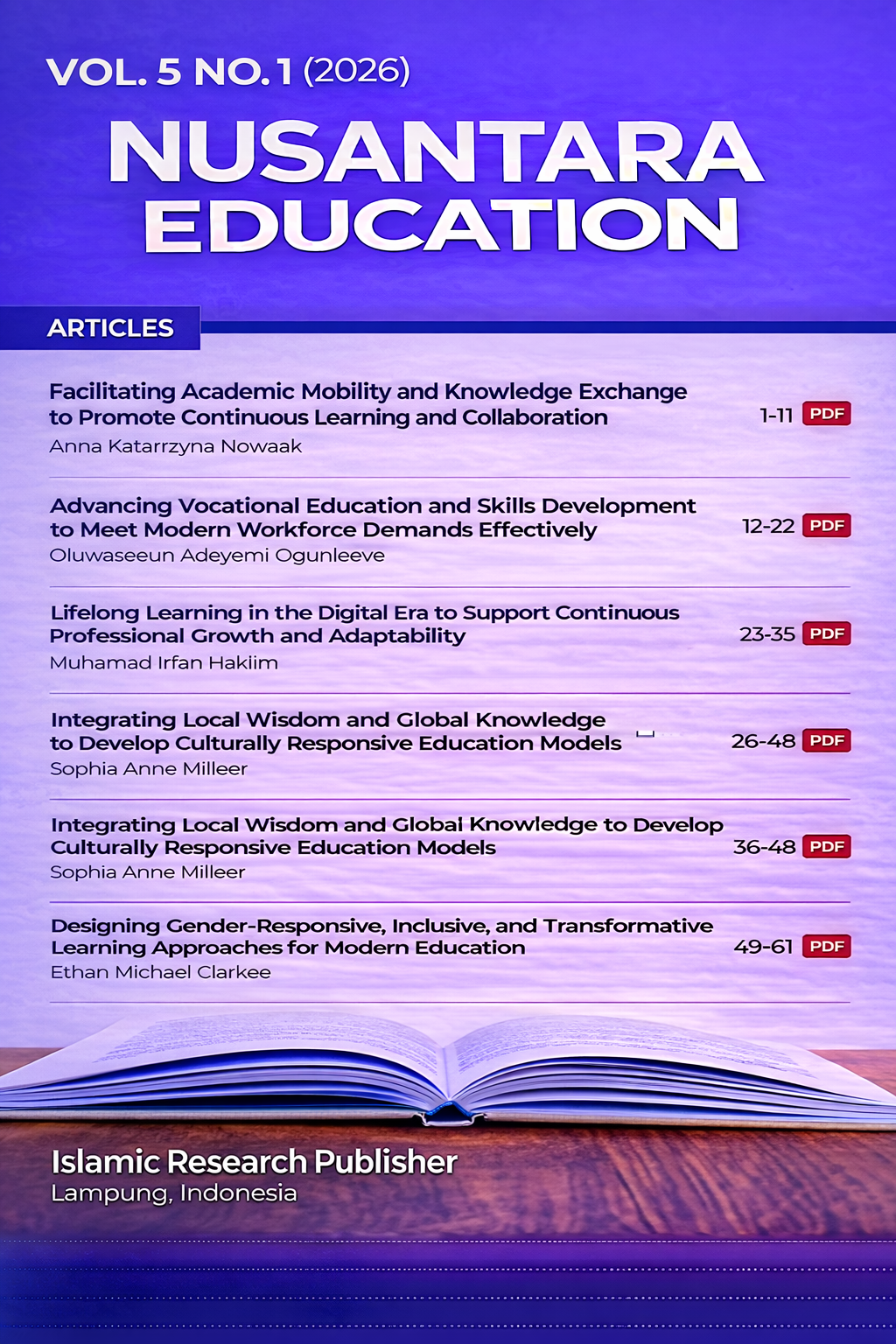
Advancing Vocational Education and Skills Development to Meet Modern Workforce Demands Effectively
DOI:
https://doi.org/10.66325/nusantaraeducation.v5i1.255Keywords:
Competency-Based Education; Digital Skills; Industry Collaboration; Vocational Education; Workforce Development.Abstract
This study examines strategic approaches to advancing vocational education and skills development in response to the evolving demands of the modern workforce. The primary objective is to analyze how vocational education systems can be restructured to enhance graduates’ employability, adaptability, and alignment with industry needs in an era characterized by rapid technological transformation and globalization. The research employs a qualitative field approach, drawing on primary data collected through interviews, observations, and document analysis within vocational education settings. These data are supported by relevant peer-reviewed journal articles, policy reports, and institutional frameworks to enrich contextual understanding. The collected data were critically examined to capture diverse perspectives on vocational education practices across different contexts. Data were analyzed through thematic analysis to identify key patterns, challenges, and innovations in vocational education. The analytical framework integrates perspectives on competency-based education, industry collaboration, and lifelong learning paradigms, grounded in empirical findings from the field. The findings reveal that effective vocational education systems are characterized by strong linkages between educational institutions and industry, the integration of digital and soft skills into curricula, and the adoption of flexible, competency-based training models. Additionally, the study highlights the importance of continuous upskilling and reskilling mechanisms to address skill gaps caused by technological disruption. However, challenges persist, including institutional rigidity, limited industry engagement, and disparities in access to quality training resources. This study contributes to the academic discourse by proposing a conceptual model that emphasizes the synergy between curriculum innovation, stakeholder collaboration, and adaptive learning ecosystems. It offers practical implications for policymakers, educators, and industry leaders in designing responsive, future-oriented, and inclusive vocational education systems. Furthermore, the research underscores the need for policy integration and cross-sectoral partnerships to ensure sustainable workforce development. Future research is recommended to empirically validate the proposed model and assess its applicability across diverse socio-economic contexts.
References
Aguiar, O. (2026). Signalling or quality improvement? The impact of institutional accreditation on employment and salaries of technical and vocational higher education graduates. Empirical Research in Vocational Education and Training, 18(1). https://doi.org/10.1186/s40461-026-00205-y
Alqahtani, A. M., Awan, K. A., Albakri, A., Jabbari, A., Aletri, O. Z., Alrakah, H. T., & Song, H. H. (2026). Federated Learning-Based Adaptive Resource Management for Sustainable 6G-IoT Ecosystems. IEEE Internet of Things Journal, 13(1), 1283–1298. https://doi.org/10.1109/JIOT.2025.3627496
Atnafu, A., Hailemariam, T., Gezie, L. D., Mamuye, A., Muluneh, D., Mengesha, M., Assaid, N., Endehabtu, B. F., & Tilahun, B. (2023). Exploring the barriers and facilitators of training as well as post-training follow-up interventions to enhance data quality and utilization: Utilizing the CFIR Implementation Framework. Ethiopian Journal of Health Development, 37(Special Issue 1), 1–14. https://doi.org/10.20372/ejhd.v37i1.5843
Barman, L., Weurlander, M., Lindqvist, H., Thornberg, R., & Wernerson, A. (2026). Protection, preparation or processing support for medical students’ emotional challenges in work-based learning—A grounded theory. Advances in Health Sciences Education. https://doi.org/10.1007/s10459-026-10512-4
Çağlar, A., Alp, E., Çetinkaya, E., & Karadeniz, O. (2026). Enhancing graduate employability through extended internships in vocational higher education: Evidence from Türkiye. International Journal of Educational Development, 121. https://doi.org/10.1016/j.ijedudev.2026.103515
Cai, Y. (2026). Pathways to Enhancing Employment Quality for Vocational College Graduates in Construction Under the Background of Intelligent Construction: The ‘Four Integrations, Three Supports, and Two Micro-Initiatives’ Model - - A Longitudinal Tracking Study Across 15 Institutions and Industry Big Data Analysis. Proc. Int. Conf. Digit. Soc. Intell. Comput., ICDSIC, 297–305. https://doi.org/10.1145/3788910.3788954
Christiansen, B., Strand, I. R., Solberg, M. T., Ravik, M., Sjølie, B. M., Kristin Ragnhildstveit Sætra, M., & Bingen, H. M. S. (2026). The curriculum—A scaffold for learning in a work-based environment. Cogent Education, 13(1). https://doi.org/10.1080/2331186X.2026.2640292
El Msayer, M., Bouihi, B., Bousselham, A., Aoula, E., & Deraoui, A. (2026). Designing Formative Adaptive Assessment for Engineering Education: Integrating Computerized Adaptive Testing and Competency-Based Diagnostic Modelling. International Journal of Engineering Pedagogy, 16(1), 133–154. https://doi.org/10.3991/ijep.v16i1.60479
Helaluddin, & Wijaya, H. (2019). Analisis Data Kualitatif: Sebuah Tinjauan Teori & Praktik. Sekolah Tinggi Theologia Jaffray.
Hollinger-Smith, L. M. (2026). Headwinds or Tailwinds? Navigating Competency-Based Education Research Methodologies. Nursing Education Perspectives, 47(2), 133–134. https://doi.org/10.1097/01.NEP.0000000000001514
Huangfu, D., & Chang, Y. F. (2026). Job competence gap of quantity surveying graduates of higher vocational colleges with a high dimensional measurement error model. PLOS ONE, 21(2 February). https://doi.org/10.1371/journal.pone.0328617
Isik, V., Ozdemir, M. C., & Cakmak, B. Y. (2025). Do Support Mechanisms Ensure a Smooth Labor Market Transition? A Cross-Cultural Qualitative Study on Vocational High School Graduates in Turkiye. SAGE Open, 15(4). https://doi.org/10.1177/21582440251375206
Jeong, S. J. (2026). Quality of Employment of High School Graduates: Focusing on the Effect of Student Vocational Education and Training Experience. International Journal of Training and Development. https://doi.org/10.1111/ijtd.70024
Jian, X., & Sun, S. (2026). Exploring AI-Driven Employment Platforms: A Case Study on Vocational College Graduates’ Survey Data Using RealMLP with Strong Meta-Tuned Default Parameters. Proc. Int. Conf. Comput. Technol., Digit. Media Commun., ICCDC, 478–485. https://doi.org/10.1145/3783669.3783743
Köfter, B., Altundağ, C. K., & Yücel, A. S. (2025). A step beyond in industrial chemistry education: Digitalization and sustainability. In W. Z. Saad, N. A. Alias, C. M. Chong, & S. Sabri (Eds), Digital Transformation and Sustainability in Higher Education (pp. 133–170). IGI Global. https://doi.org/10.4018/979-8-3373-5077-6.ch006
Lam, N., Tee, M. C., Nembhard, C. E., Son, Y. A., Anand, A., Arnow, K., Tsai, J., Peralta, F. C., Melcer, E. F., Liebert, C. A., & Lin, D. T. (2026). Multi-Institutional Analysis of Entrust Performance With Competency-Based Surgical Education Metrics. Journal of Surgical Education, 83(5). https://doi.org/10.1016/j.jsurg.2026.103887
Leal Filho, W., Diver, C., Anholon, R., Rampasso, I. S., Salvia, A. L., Velazquez, L., Sharifi, A., Ávila, L. V., & Munguia, N. (2026). Digitalisation for Sustainable Development in an Industrial Context. Sustainable Development, 34(S2), 908–923. https://doi.org/10.1002/sd.70353
Li, Y., Zhang, C., Guo, Z., Yang, N., Yuan, D., & Ding, W. (2026). SafeTwinNet: Secure and Adaptive Learning Ecosystems for Digital Twins. IEEE Communications Standards Magazine. https://doi.org/10.1109/MCOMSTD.2025.3649865
Loh, K. W., Thevaraj, P. N., Ayob, K. A., Tan, S. L., Wong, L. P., & Abbas, A. A. (2026). Immersive virtual reality simulation training enhances technical skill acquisition and procedural accuracy in cadaveric total knee arthroplasty. Archives of Orthopaedic and Trauma Surgery, 146(1). https://doi.org/10.1007/s00402-025-06164-5
Madanayake, U. H., Ayinla, K. O., & Saka, A. B. (2026). An investigation of learner types and their unique preferences on the work-based learning (WBL) model: A case of quantity surveying apprenticeship. Construction Management and Economics, 44(1), 1–22. https://doi.org/10.1080/01446193.2025.2571628
Mansuy, M., & Recotillet, I. (2025a). Horizontal mismatch among Moroccan vocational training graduates at labour market entry. Formation Emploi, 2025-October-December(172). https://doi.org/10.4000/153h7
Mansuy, M., & Recotillet, I. (2025b). Vertical mismatch among vocational training graduates in Morocco. Formation Emploi, 2025-October-December(172). https://doi.org/10.4000/153hb
Masrifah, N., & Sudira, P. (2020). Redesign of Vocational Education Curriculum in Industrial Digitalization 4.0. ACM Int. Conf. Proc. Ser., 25–29. https://doi.org/10.1145/3401861.3401865
McDonagh, D. (2026). The role of clinical competency-based education in training in radiation science: A scoping review. Journal of Medical Imaging and Radiation Sciences, 57(3). https://doi.org/10.1016/j.jmir.2026.102337
Nika, D. (2025). Social inequalities at the transition to higher education: The role of personality for graduates from vocational and general schools. Empirical Research in Vocational Education and Training, 17(1). https://doi.org/10.1186/s40461-025-00181-9
Nowaak, A. K. (2026). Facilitating Academic Mobility and Knowledge Exchange to Promote Continuous Learning and Collaboration. Nusantara Education, 5(1), 1–12. https://doi.org/10.66325/nusantaraeducation.v5i1.254
Nyale, D., Karume, S., Kipkebut, A., Mukudi, F., & Sharafat, A. (2026). An intelligent curriculum alignment model for digital skills integration in higher education: A data-driven approach to bridge academia-industry gaps. Discover Education, 5(1). https://doi.org/10.1007/s44217-026-01180-y
Ogbuanya, C. T., & Adebayo, T. F. (2026). Effect of self-directed learning on student’s engagement in practical skills acquisition in electrical installation and maintenance work in Nigeria. Industry and Higher Education, 40(2), 285–301. https://doi.org/10.1177/09504222251375629
Olofsson, M. (2026). Inclusion on fragile ground: Supporting students with special educational needs in Swedish work-based learning. Journal of Research in Special Educational Needs, 26(2). https://doi.org/10.1111/1471-3802.70065
Pakala, Y., & Guniganti, S. (2026). Advancing Digital Extension Education: Development and Validation of Digital Learning Engagement Scale. Indian Journal of Extension Education, 62(1), 159–165. https://doi.org/10.48165/IJEE.2026.621RT04
Prikhodko, A., & Akhmetshin, E. (2021). Peer-to-Peer Grading as a Way to Improve Educational Process Efficiency for Certain Industrial Sectors under Digitalization of Education at Universities. ACM Int. Conf. Proc. Ser. ACM International Conference Proceeding Series. https://doi.org/10.1145/3487757.3490860
Raghavan, N., Patel, P. C., Limon, D., Morris, M. X., Kempenich, J. W., & Rajesh, A. (2026). Artificial Intelligence in Surgical Education: A 2025 Update on Adaptive Training, Feedback, and Competency-Based Education. The American Surgeon, 92(3), 675–686. https://doi.org/10.1177/00031348251397597
Rahman, Y. A. (2025). Developing Inclusive Education Models to Advance Gender Justice and Social Equity for All Learners. Nusantara Education, 4(2), 11–19. https://doi.org/10.66325/nusantaraeducation.v4i2.249
Reitsma, T., Cnossen, F., & Venhorst, V. A. (2026). Hometown Glory – the Benefits of Location-Specific Capital for Labour Market Outcomes of Vocational Education Graduates. Population, Space and Place, 32(2). https://doi.org/10.1002/psp.70218
Sharma, J., Deswal, H., Kaushal, J., & Rohilla, S. (2026). Perception of MBBS Students About Pharmacology Teaching in New Competency-based Medical Education (CBME) Curriculum at a Tertiary Care Medical Institute of Haryana. Journal of Pharmacology and Pharmacotherapeutics, 17(2), 199–205. https://doi.org/10.1177/0976500X251336881
Shoaib, M., Afridi, M. U., & Husnain, G. (2026). Forecasting algorithm for the vocational mobility of graduates with multiple attributes. Expert Systems with Applications, 297. https://doi.org/10.1016/j.eswa.2025.129463
Singh, D., & Soni, R. (2026). The role of life skills education and grit in adolescent resilience in the digital age. Discover Psychology, 6(1). https://doi.org/10.1007/s44202-026-00605-x
Suyatmo, S., Prayitno, H., Wirawan, W. A., Pratiwi, D. I., & Waluyo, B. (2025). Preparing industry-ready graduates: Interplay of lecturer behavior, self-motivation, and soft skill development in vocational education. Acta Psychologica, 261. https://doi.org/10.1016/j.actpsy.2025.105892
Toma, V., & Borici, A. (2025). Educational Pathways and Employment Stability: A Comparative Study of Vocational and University Graduates in the Tourism Sector of Northern Albania. European Journal of Social Science Education and Research, 12(4), 44–61. https://doi.org/10.26417/a3mnxs64
Verdier, É., & Rachik, H. (2025). Diversification of learning paths for Moroccan vocational training graduates: Towards new inequalities? Formation Emploi, 2025-October-December(172). https://doi.org/10.4000/153ha
Wan, J., Wang, Q., Zhang, Y., & Liu, Y. (2026). Digital intelligence empowerment for future bioengineering education building a competency based teaching system under emerging engineering paradigm. Shengwu Gongcheng Xuebao/Chinese Journal of Biotechnology, 42(3), 1404–1412. https://doi.org/10.13345/j.cjb.250809
Yasin, N., Bilgic, E., & Zubairi, M. S. (2026). Artificial Intelligence Augmented Competence Committees: A Collaborative Path Forward in Competency-Based Medical Education. Clinical Teacher, 23(2). https://doi.org/10.1111/tct.70358
Zheng, J. H., Lee, M. F., & Zhang, B. L. (2025). Bridging the Gap: Aligning Vocational Graduates’ Competencies with Employer Expectations Using the KSAO Model. International Journal of Integrated Engineering, 17(4), 209–216. https://doi.org/10.30880/jtet.2025.17.04.016
Downloads
Published
Issue
Section
License
Copyright (c) 2026 Oluwaseeun Adeyemi Ogunleeye

This work is licensed under a Creative Commons Attribution-ShareAlike 4.0 International License.