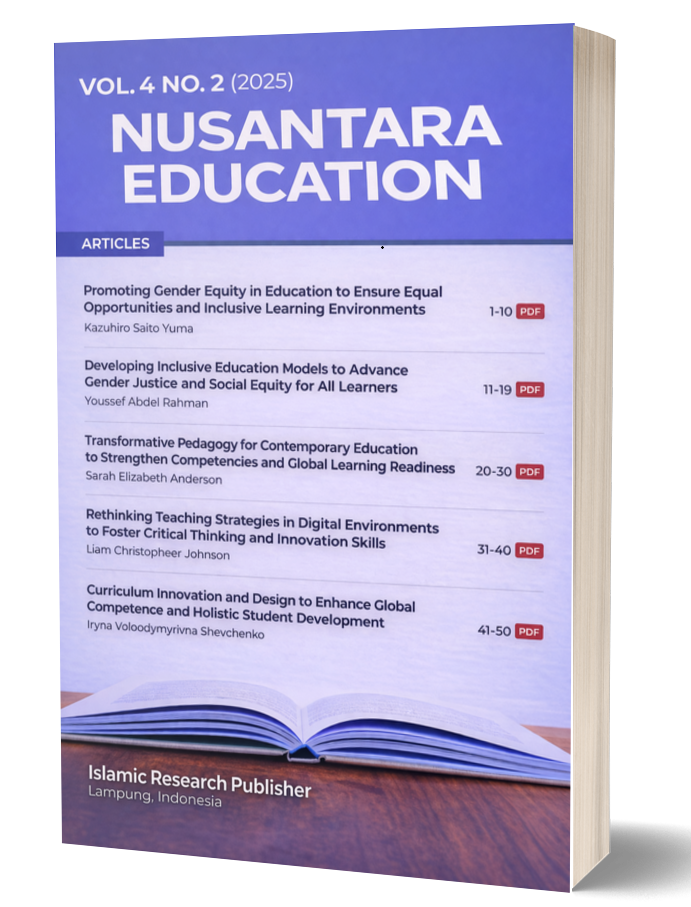
Curriculum Innovation and Design to Enhance Global Competence and Holistic Student Development
DOI:
https://doi.org/10.66325/nusantaraeducation.v4i2.253Keywords:
Child Rape; Judicial Reasoning; Secondary Victimisation; Victim Blaming; Victimology.Abstract
This study explores curriculum innovation and design to enhance students’ global competence and promote holistic development. Recognising the increasing demands of a rapidly globalising world, educational institutions are challenged to equip students not only with disciplinary knowledge but also with critical thinking, intercultural awareness, and socio-emotional skills. The research aims to identify effective curriculum strategies that foster both cognitive and non-cognitive competencies, thereby preparing learners for complex global challenges. A mixed-methods approach was employed, integrating qualitative analysis of curriculum frameworks and policy documents with quantitative evaluation of student outcomes across multiple higher education institutions. Data collection included in-depth interviews with curriculum developers, surveys of students’ perceived competencies, and analysis of academic performance indicators. The thematic analysis focused on key dimensions of global competence—such as cross-cultural communication, ethical reasoning, and adaptability—while also examining the integration of holistic educational practices, including character building, creativity, and well-being initiatives. Findings indicate that curricula emphasising interdisciplinary learning, experiential projects, and international collaboration significantly enhance students’ global awareness and interpersonal skills. Moreover, programs that embed reflective practices, mentorship, and co-curricular activities contribute to holistic development by fostering emotional resilience, ethical judgment, and lifelong learning dispositions. The study also highlights challenges in aligning institutional policies with innovative practices, emphasising the need for faculty development, resource allocation, and continuous assessment mechanisms. This research contributes to the academic discourse on curriculum design by providing empirical evidence and practical guidelines for cultivating globally competent and well-rounded graduates. It underscores the importance of integrated pedagogical approaches that balance knowledge acquisition, skill development, and personal growth, offering a model adaptable across diverse educational contexts. The findings inform policymakers, educators, and curriculum designers seeking to advance educational quality in alignment with 21st-century competencies.
References
Aguilar, P., & Heusser, P. (2023). The Geneva Global Hub for Education in Emergencies: A new ally for education in emergencies. Prospects, 53(1–2), 3–13. https://doi.org/10.1007/s11125-022-09609-6
Aguilar-Correa, C. M. (2023). The Environmental Problems in the Context of Global Change: Possibilities and Limitations of Eco-Scientific Education from a Teaching Perspective. Revista Electronica Educare, 27(2). https://doi.org/10.15359/ree.27-2.15904
Brink, S., Wikberg-Nilsson, Å., de Hei, M., Sjoer, E., & Admiraal, W. (2025). Student personas and their learner journeys in co-creative curriculum innovation. Discover Education, 4(1). https://doi.org/10.1007/s44217-025-00980-y
Calabrese, J. E., Songer, N. B., Cordner, H., & Kalani Aina, D. (2025). How do we design curricula to foster innovation, motivation and interest in STEM learning? Journal of Research in Innovative Teaching & Learning, 18(2), 269–284. https://doi.org/10.1108/JRIT-06-2023-0064
Clark, L. C. (2025). Empowering Women through Education by Implementing Gender-Responsive and Transformative Pedagogies. Nusantara Education, 4(01), 46–54. https://doi.org/10.66325/nusantaraeducation.v4i1.246
Clark, S., Gallagher, E., Boyle, N., Barrett, M., Hughes, C., O’Malley, N., Ebuenyi, I., Marshall, K., & O’Sullivan, K. (2023). The International Education Index: A global approach to education policy analysis, performance and sustainable development. British Educational Research Journal, 49(2), 266–287. https://doi.org/10.1002/berj.3842
Dröse, J., Ahlemeyer, L., & Prediger, S. (2025). How curriculum materials can contribute to implementing instructional innovations: The case of enactment of strategy instruction. ZDM – Mathematics Education, 57(5), 1019–1034. https://doi.org/10.1007/s11858-025-01662-7
Farouk, Y. M. (2025a). Applying Indigenous Knowledge in Education for Lifelong Skills Development and Student Empowerment. Nusantara Education, 4(01), 13–25. https://doi.org/10.66325/nusantaraeducation.v4i1.242
Farouk, Y. M. (2025b). Applying Indigenous Knowledge in Education for Lifelong Skills Development and Student Empowerment. Nusantara Education, 4(01), 13–25. https://doi.org/10.66325/nusantaraeducation.v4i1.242
Fergus, A., Delbridge, A., & Sutton, S. (2025). Perspectives of a Telehealth and In-Person Collaborative Learning Experience on Infant Development: A Mixed-Method Study. Physical and Occupational Therapy in Pediatrics. https://doi.org/10.1080/01942638.2025.2591849
Inglis, P. (2023). Critical approaches to private education in the Global South. Sociology Compass, 17(5). https://doi.org/10.1111/soc4.13080
Kauffman, L., Weisberg, E. M., & Fishman, E. K. (2023). Social Media Usage for Radiology Education: A One-Month 2022 Global Survey. Current Problems in Diagnostic Radiology, 52(3), 153–163. https://doi.org/10.1067/j.cpradiol.2023.01.007
Kavuma, A., Kibudde, S., Schmidt, M., Zhao, T., Gay, H., Li, B., Michalski, J., Hugo, G., Vanchinbazar, E., Minjgee, M., Nansalmaa, E., Ssewamala, F., Velarde, A., De Fella, V., Ixquiac, M., Henke, L., van Rheenen, J., & Sun, B. (2023). Remote Global Radiation Oncology Education and Training: A Pathway to Increase Access to High-Quality Radiation Therapy Services in Low- and Middle-Income Countries. Advances in Radiation Oncology, 8(3). https://doi.org/10.1016/j.adro.2023.101180
Lerch, J. C. (2023). How Global Institutions Matter: Education for All and the Rise of Education as a Humanitarian Response. Comparative Education Review, 67(2), 251–276. https://doi.org/10.1086/724176
Li, X., Zhou, S., & He, Z. (2023). From online planning education to future planning education in a global view: A case study of online engineering education in MOOCs and its characteristics. Computer Applications in Engineering Education, 31(3), 755–776. https://doi.org/10.1002/cae.22606
Lu, J., Kinley, P. M., & Feldman, M. (2025). “Let’s beat cancer together”: A hidden curriculum of medical gentrification on the biomedical innovation frontier. Social Science & Medicine, 383, 118167. https://doi.org/10.1016/j.socscimed.2025.118167
Mérida, A. J. A., Mora, M. D. R. H., Rocío, C. B. E., & Castillo, M. D. P. J. (2025). Innovation In Early Childhood Education Through Curriculum Adaptations For Inclusion And Integral Development. Architecture Image Studies, 6(3), 1355–1367. https://doi.org/10.62754/ais.v6i3.459
Mika, S. N. (2025a). Leveraging Indigenous Knowledge through Technology to Enhance Creativity and Critical Thinking in Students. Nusantara Education, 4(01), 36–45. https://doi.org/10.66325/nusantaraeducation.v4i1.245
Mika, S. N. (2025b). Leveraging Indigenous Knowledge through Technology to Enhance Creativity and Critical Thinking in Students. Nusantara Education, 4(01), 36–45. https://doi.org/10.66325/nusantaraeducation.v4i1.245
Miles, M. B., & Huberman, A. M. (2014). Analisis data kualitatif: Buku sumber tentang metode-metode baru. Universitas Indonesia Press.
Miller, C. M., Cramer, S. R., Aney, S. J., Edmiston, K., Holmes, S., Mello, S., Shetty, P., Studer, K., & Rea, B. (2025). The Innovation, Implementation, and Dissemination of the Lifestyle Medicine Residency Curriculum (LMRC) in Graduate Medical Education. American Journal of Lifestyle Medicine, 19, 10S-20S. https://doi.org/10.1177/15598276251393211
Nolan, L. K., Lamb, R., Marks, J., & Carter, A. H. (2025). Innovation in the curriculum hones clinical skills. Journal of the American Veterinary Medical Association, 263(10), 1329. https://doi.org/10.2460/javma.25.08.0528
Pancheshnikov, A., Cuneo, C. N., Matias, W. R., Cázares-Adame, R., Santos López, A. G., Paxton, R. M., & Chen, C. C. G. (2023). Case studies in adaptation: Centring equity in global health education during the COVID-19 pandemic and beyond. BMJ Global Health, 8(4). https://doi.org/10.1136/bmjgh-2023-011682
Rachid, M., Eljai, M., Berdi, A., & Seghyar, N. (2025). Generative AI in the Service of Collaborative Learning in Morocco: Opportunities and Challenges. Int. Conf. Circuit, Syst. Commun., ICCSC. 2025 International Conference on Circuit, Systems and Communication, ICCSC 2025. https://doi.org/10.1109/ICCSC66714.2025.11135203
Ramli, R., Razali, R., Gadeng, A. N., Diana, N., & Hariadi, J. (2025). Integrating Local Knowledge into Higher Education: A Qualitative Study of Curriculum Innovation in Aceh, Indonesia. Education Sciences, 15(9), 1214. https://doi.org/10.3390/educsci15091214
Remadnia, O., Maazouzi, F., & Chefrour, D. (2025). Hybrid Book Recommendation System Using Collaborative Filtering and Embedding Based Deep Learning. Informatica (Slovenia), 49(8), 189–204. https://doi.org/10.31449/inf.v49i8.6950
Ren, X., & Zhou, Y. (2025). Non-traditional learners’ immediate and delayed responses to anonymous peer feedback in online collaborative learning. Interactive Learning Environments, 33(9), 5269–5286. https://doi.org/10.1080/10494820.2025.2479167
Rosidin, A., Sudirman, S., Mufti, M. I., Pramono, S. A., Susanty, L., Dudin, A., Ernawati, Arifin, A., & R, M. D. (2025). Exploring Educational Policy Innovations and Curriculum Development in Indonesian Higher Education: A Systematic Review. Journal of Education Culture and Society, 16(2), 943–958. https://doi.org/10.15503/jecs2025.3.943.958
Sá, M. J. (2023). A Multidimensional Model of Analysis of Students’ Global Experience in Higher Education. Education Sciences, 13(3). https://doi.org/10.3390/educsci13030232
Santos, Í., & Pekkola, E. (2023). Policy entrepreneurs in the global education complex: The case of Finnish education experts working in international organisations. International Journal of Educational Development, 98. https://doi.org/10.1016/j.ijedudev.2023.102749
Slimi, Z., & Carballido, B. V. (2023). Navigating the Ethical Challenges of Artificial Intelligence in Higher Education: An Analysis of Seven Global AI Ethics Policies. TEM Journal, 12(2), 590–602. https://doi.org/10.18421/TEM122-02
Tarbutton, T. M., & Doyle, L. B. (2023). Using Teacher Presence in Online Higher Education to Foster Global Citizenship among Adult Learners. Athens Journal of Education, 10(2), 233–248. https://doi.org/10.30958/aje.10-2-3
Umami, H., Azmil, R., & Firmansah, D. (2025). Enhancing Learning Outcomes in Islamic Cultural History Using the Think-Talk-Write Model. Nusantara Education, 4(01), 1–12. https://doi.org/10.66325/nusantaraeducation.v4i1.123
White, P. J., Guilding, C., Angelo, T., Kelly, J. P., Gorman, L., Tucker, S. J., Fun, A., Han, J., Chen, G., Samak, Y., Babey, A.-M., Caetano, F. A., Sarangi, S. C., Koenig, J., Hao, H., Goldfarb, J., Karpa, K., Vieira, L., Restini, C., … Liu, Y. (2023). Identifying the core concepts of pharmacology education: A global initiative. British Journal of Pharmacology, 180(9), 1197–1209. https://doi.org/10.1111/bph.16000
Yadav, P., Raffel, C., Muqeeth, M., Caccia, L., Liu, H., Chen, T., Bansal, M., Choshen, L., & Sordoni, A. (2025). A Survey on Model MoErging: Recycling and Routing Among Specialised Experts for Collaborative Learning. Transactions on Machine Learning Research, 2025-April.
Yu, H., & Zhang, S. (2025). Collaborative task decision-making of multi-UUV in dynamic environments based on deep reinforcement learning. Ships and Offshore Structures, 20(9), 1272–1282. https://doi.org/10.1080/17445302.2024.2391788
Zhang, Z., Zhao, D., Liu, R., Yao, Y., Li, X., & Ma, H. (2025). ACL: Adaptive Edge-Cloud Collaborative Learning for Heterogeneous Devices With Unlabeled Local Data. IEEE Transactions on Mobile Computing, 24(9), 8152–8166. https://doi.org/10.1109/TMC.2025.3553971
Zhao, J. (2025). Multi-Agent Reinforcement Learning with Graph Convolutional Networks for Collaborative Task Scheduling in Distributed Virtual Reality Systems. Journal of Computing and Information Technology, 33(4), 249–266. https://doi.org/10.20532/cit.2025.1006202
Downloads
Published
Issue
Section
License
Copyright (c) 2025 Iryna Voloodymyrivna Shevchenko

This work is licensed under a Creative Commons Attribution-ShareAlike 4.0 International License.