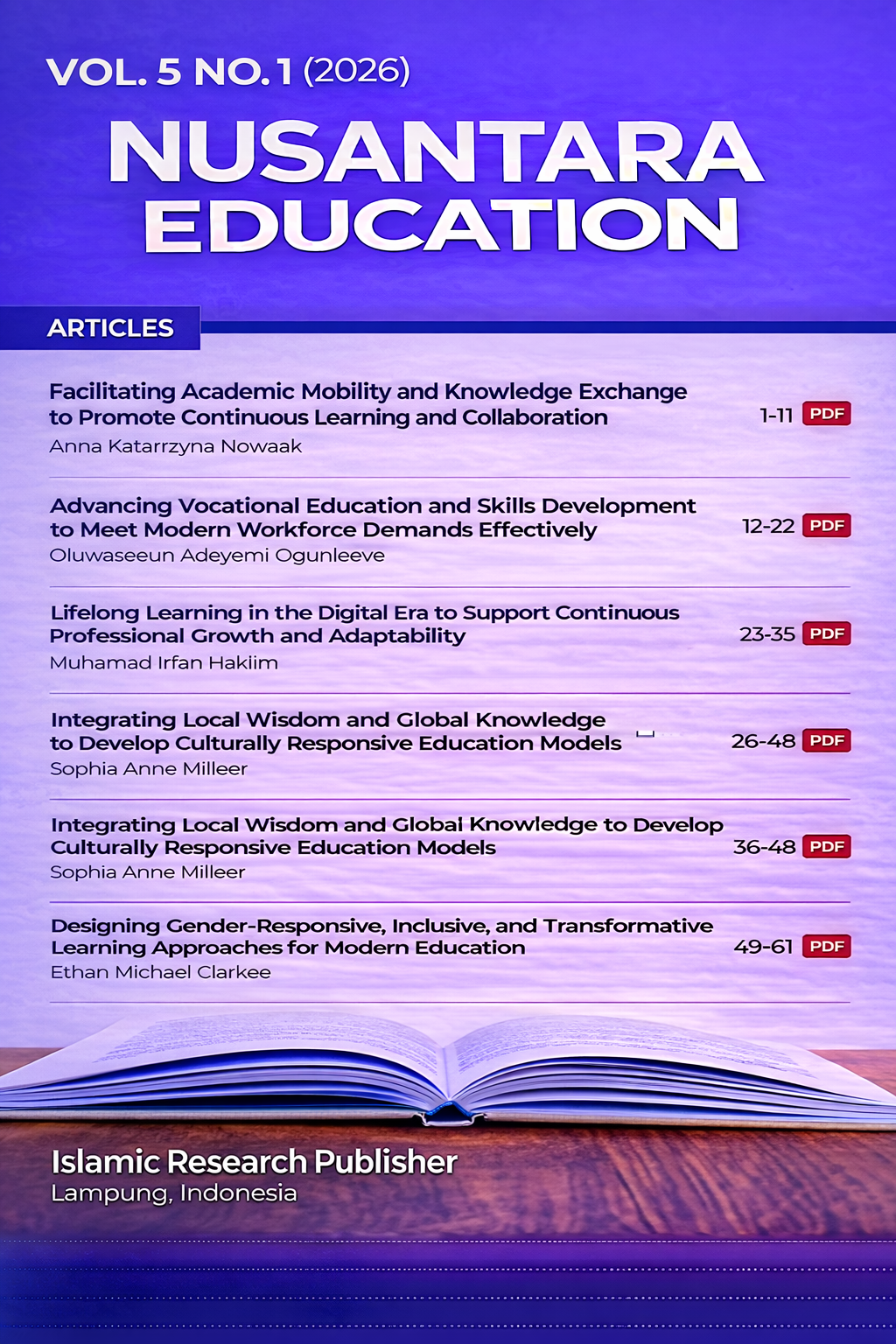
Designing Gender-Responsive, Inclusive, and Transformative Learning Approaches for Modern Education
DOI:
https://doi.org/10.66325/nusantaraeducation.v5i1.258Keywords:
Gender-Responsive Learning; Inclusive Education; Modern Education; Transformative Pedagogy; Equity in Education.Abstract
This study aims to design a gender-responsive, inclusive, and transformative learning approach that aligns with the demands of modern education. It addresses persistent challenges related to gender bias, unequal participation, and limited pedagogical innovation in contemporary learning environments. This study employs a qualitative field research design to examine gender-inclusive pedagogy in practice. Data were collected through interviews, observations, and documentation involving selected educators and stakeholders. Data were analyzed using thematic analysis and an interpretive approach to identify key patterns and construct a transformative education model, with validity ensured through triangulation. The findings reveal that gender-responsive and inclusive learning requires integrating three key dimensions: equitable curriculum design, participatory pedagogical strategies, and reflective institutional practices. First, curriculum content must be reconstructed to eliminate gender bias and represent diverse perspectives. Second, teaching methods should promote active engagement, critical thinking, and equal participation among all learners, regardless of gender or social background. Third, institutional support systems, including teacher training and policy frameworks, play a crucial role in sustaining inclusive practices. Furthermore, the study identifies that transformative learning emerges when learners are encouraged to critically examine social norms, develop empathy, and engage in collaborative knowledge construction. This research contributes to the academic discourse by proposing an integrated model that bridges gender responsiveness, inclusivity, and transformative pedagogy within a unified framework. It offers practical implications for educators, curriculum developers, and policymakers seeking to foster equitable and adaptive learning environments. By emphasizing the intersection of gender equity and educational transformation, this study provides a conceptual foundation for advancing more just, inclusive, and future-oriented education systems in diverse socio-cultural contexts.
References
Aafaf, E., Sabah, B., Marya, B., Aziz, B., Mohamed, E. H., & Smail, B. (2025). Assessment of the personnel-efficacy of Moroccan teachers and future teachers in the practice of gender-responsive pedagogy: Case study of the Casablanca-Settat region. Frontiers in Education, 10, 1602163. https://doi.org/10.3389/feduc.2025.1602163
Ahmed, O. I. M., Al-Bukhrani, M. A., & Abdulraheem, S. G. M. (2026). ESG practices and critical reflection foster transformative learning outcomes in Saudi Arabian tourism education. Discover Sustainability, 7(1). https://doi.org/10.1007/s43621-026-02874-x
Appari, G. D., Begum, S. S., Kocharla, S., Pappula, M., Gorikapudi, S., & Tirumalasetti, N. R. (2026). Multi-Task Deep Learning Framework for Segmentation and Severity Estimation of Leaf Diseases in Multi-Crop Environments. International Journal of Innovative Technology and Interdisciplinary Sciences, 9(1), 210–237. https://doi.org/10.15157/IJITIS.2026.9.1.210-237
Byenkya, N. L., Rose, N., & Nixson, O. (2026). Adaptive object detection in dynamic road environments using YOLOv11 with continuous learning for Real-Time obstacle detection. Discover Artificial Intelligence, 6(1), 116. https://doi.org/10.1007/s44163-025-00828-2
Castro, C. R., & Gil, I. G. (2025). The Newspaper El Sol and Education: The Supplement of Pedagogy and Public Instruction (1917-1921). Espacio, Tiempo y Educacion, 12(1), 42–62. https://doi.org/10.14516/ete.12103
Chaisawasthomrong, C., & Boongird, A. (2026). Comparison of clinical preceptorship and small group discussion as educational modalities in modern neurosurgical education: Outcomes and perspectives. BMC Medical Education, 26(1), 239. https://doi.org/10.1186/s12909-026-08587-z
Clark, L. C. (2025). Empowering Women through Education by Implementing Gender-Responsive and Transformative Pedagogies. Nusantara Education, 4(01), 46–54. https://doi.org/10.66325/nusantaraeducation.v4i1.246
Clark, S. E., Johnson, S., Martinez, S., & Chunoo, V. S. (2026). Leadership Learning in Study Centers Abroad: A Transformative Experience. New Directions for Student Leadership, 2026(189), 103–108. https://doi.org/10.1002/yd.70044
Dharmarathna, A. B., Mishra, S. K., & Bhatt, A. A. (2026). Health Education and Counseling to enhance the Self-Health Care; A Review of Ayurveda & Modern medical perspectives. Journal of Ayurveda and Holistic Medicine, 14(1), 51–59. https://doi.org/10.70066/jahm.v14i1.2380
Estaji, M., Momeni, A., & Brown, G. T. L. (2026). Transformative learning in teacher development: The impact of a teacher education course on EFL teachers’ perceptions and experiences of the emotional dimensions of language assessment literacy. Language Testing in Asia, 16(1). https://doi.org/10.1186/s40468-026-00434-8
Garand, A. T. (2025). Divo Ti Vyin? Where Are You From? Red River Métis Knowledge as Pedagogy. Canadian Journal of Education, 48(3), 917–937. https://doi.org/10.53967/cje-rce.7503
Greany, T., Thomson, P., Perry, T., & Collins, M. (2025). Signature pedagogies for leadership development: A comparison of headteacher preparation programmes in England and Scotland. London Review of Education, 23(1). https://doi.org/10.14324/LRE.23.1.18
Hanafi, Y., Saefi, M., Ikhsan, M. A., Diyana, T. N., Ahsanuddin, M., Alfan, M., Yani, M. T., Hazin, M., Chamidah, D., & Mustakim, S. S. (2025). Unveiling the intersection of technology and pedagogy: A domain-specific exploration for developing religious moderation content with an exploratory and Rasch Perspective. British Journal of Religious Education, 47(4), 552–565. https://doi.org/10.1080/01416200.2024.2427303
Herman, N. D., Maknun, J., Busono, T., & Krisnanto, E. (2026). Development of transformative learning model in construction workers training for building work field implementers to support disaster mitigation efforts in earthquake-prone areas. Multidisciplinary Science Journal, 8. https://doi.org/10.31893/multiscience.2026214
Huang, L., & Kearney, E. (2026). Novice Mandarin learners’ transformative learning through critical virtual exchange: A multimodal, translanguaging design. Foreign Language Annals, 59(1), 141–165. https://doi.org/10.1111/flan.70034
Hur, J. W., & Kim, J. Y. (2026). From West to East: American Educators’ Transformative Learning Experiences in South Korea. Journal of Transformative Education, 24(2), 150–169. https://doi.org/10.1177/15413446251405178
Jóźwik, R. (2026). Pop-up and microscale urban living labs are seeds of sustainable urban transformation? An analysis of knowledge transfer and the mechanism of transformative learning. Cities, 172. https://doi.org/10.1016/j.cities.2026.106915
Khalil, N., Aljanazrah, A., Hamed, G., & Murtagh, E. M. (2024). Teacher educators’ perspectives on gender responsive pedagogy in higher education. Irish Educational Studies, 43(4), 903–919. https://doi.org/10.1080/03323315.2023.2174575
Kheang, S., Lin, X., & Charungkaittikul, S. (2026). Exploring Transformative Learning Theory in Asian Contexts. Journal of Transformative Education, 24(2), 147–149. https://doi.org/10.1177/15413446251414232
Kim, R. J.-H. (2026). Authenticity and Empowerment: Asian American Women Leaders and the Impacts of Transformative Learning in Higher Education. Journal of Transformative Education, 24(2), 318–335. https://doi.org/10.1177/15413446251401096
Liu, Y., Sun, H., Li, W., & He, Y. (2026). Advancing traffic object detection in complex environments: A deep learning object detection approach with vehicle-mounted UAV data for traffic scene perception. Knowledge and Information Systems, 68(1), 12. https://doi.org/10.1007/s10115-025-02621-0
Lu, Q. (2026). Interactive art forms and gamification in modern art education: Transforming art creation and perception. Education and Information Technologies, 31(5), 1459–1479. https://doi.org/10.1007/s10639-025-13856-3
Lumbard, J. E. B. (2025). Islam, coloniality, and the pedagogy of cognitive liberation in higher education. Teaching in Higher Education, 30(6), 1409–1419. https://doi.org/10.1080/13562517.2025.2468974
Makamure, G. (2025). Promoting gender-responsive pedagogies in open education at Eswatini’s higher education institutions. SN Social Sciences, 5(10), 162. https://doi.org/10.1007/s43545-025-01202-w
Mohd Daud, N. (2026). Resisting the machine: Modeling emotional friction and academic decline in enforced AI learning environments. Smart Learning Environments, 13(1), 10. https://doi.org/10.1186/s40561-026-00435-3
Mukagiahana, J., Sibomana, A., & Ndiritu, J. (2024). Teachers understanding of gender responsive pedagogy and its application in teaching process: Case after teacher training program interventions in Rwanda. Journal of Pedagogical Research, 1. https://doi.org/10.33902/JPR.202423067
Munandar, M. I. (2025). Interculturality, native-speakerism and authenticity: Paradoxes in Indonesia’s EFL pedagogy. Pedagogy, Culture and Society, 33(2), 689–709. https://doi.org/10.1080/14681366.2023.2298441
Puente, K., & Darwich, L. (2026). Bridging the Gap Between Transformative Social and Emotional Learning and Motivation. Journal of Education, 206(2), 103–114. https://doi.org/10.1177/00220574251349728
Rahman, Y. A. (2025). Developing Inclusive Education Models to Advance Gender Justice and Social Equity for All Learners. Nusantara Education, 4(2), 11–19. https://doi.org/10.66325/nusantaraeducation.v4i2.249
Reihling, H., Jones, N. R., Nager, E., & Juarez, M. L. (2026). Assessing Refugee Trauma: Transformative Clinical Training in a Community Service-Learning Model. Journal of Marital and Family Therapy, 52(2). https://doi.org/10.1111/jmft.70118
Rutledge, J. D., Abrams, J., Opara, I., & Miller, R. L. (2026). Navigating an STI diagnosis: The role of social support, intergenerational learning, and transformative growth among Black women. American Journal of Community Psychology, 77(1–2), 118–132. https://doi.org/10.1002/ajcp.70011
Scheiner, T. (2026). Transformative learning: Noticing student strengths through frame shifting. ZDM - Mathematics Education, 58(1–2), 263–278. https://doi.org/10.1007/s11858-025-01715-x
Seni, A. J. (2026). Utilisation of gender responsive pedagogy in classroom instructions among secondary school Mathematics and Science subjects in Tanzania. Cogent Education, 13(1). https://doi.org/10.1080/2331186X.2026.2616870
Shure, J. (2025). A phenomenological exploration of social pedagogy in immigrant education in the United States. International Journal of Social Pedagogy, 14(1). https://doi.org/10.14324/111.444.ijsp.2025.v14.x.013
Sun, Q., Lin, X., & Zhang, X. (2026). A Trio-Ethnographic Study of Asian and Asian Diaspora Transformative Learning Journey in the U.S.: Towards International Scholars. Journal of Transformative Education, 24(2), 276–295. https://doi.org/10.1177/15413446261430548
Ulman, I., Abbas, T., Tonnhofer, U., Braga, L. H., & Hadidi, A. T. (2026). Education and training in hypospadias surgery: Current status, competency assessment, and the role of modern educational tools. Journal of Pediatric Urology, 22(2). https://doi.org/10.1016/j.jpurol.2026.105733
Zherlitsina, N. A. (2026). Colonialism and Islamic Education: The History of the Clash and the Consequences for the Modern Development of Muslim Countries in Africa. Journal of Frontier Studies, 11(1), 189–207. https://doi.org/10.46539/jfs.v11i1.683
Downloads
Published
Issue
Section
License
Copyright (c) 2026 Ethan Michael Clarkee

This work is licensed under a Creative Commons Attribution-ShareAlike 4.0 International License.