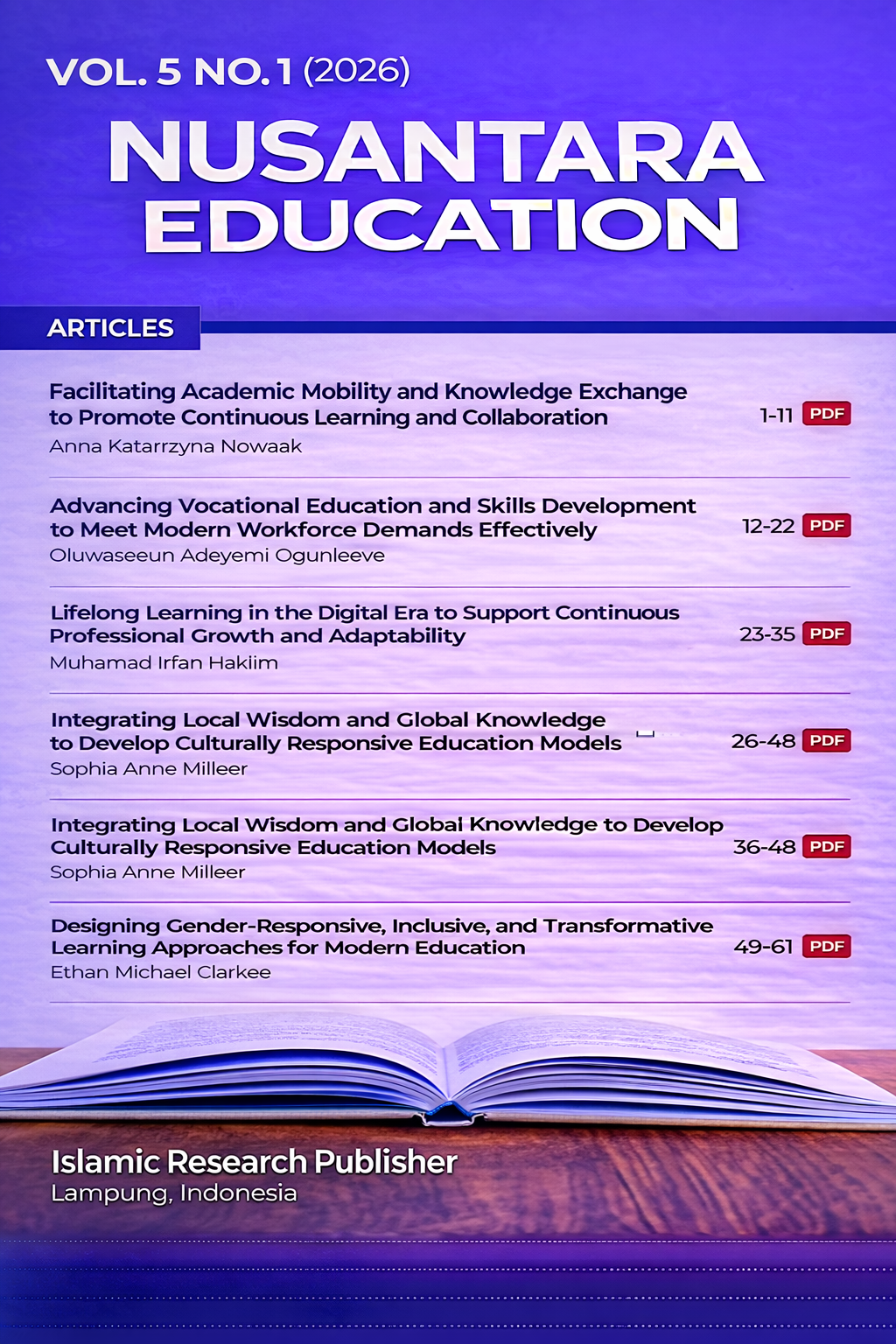
Facilitating Academic Mobility and Knowledge Exchange to Promote Continuous Learning and Collaboration
DOI:
https://doi.org/10.66325/nusantaraeducation.v5i1.254Keywords:
Academic collaboration; Academic mobility; Continuous learning; Knowledge exchange; Learning ecosystems.Abstract
This study examines the role of academic mobility and knowledge exchange in fostering continuous learning and collaborative innovation within higher education institutions. The primary objective is to analyze how mobility programs—such as student exchanges, visiting scholars, and international research collaborations—contribute to the development of adaptive learning ecosystems and sustainable academic partnerships. Employing a qualitative field research design, this study draws on primary data collected through interviews, observations, and document analysis, supported by relevant peer-reviewed articles, institutional reports, and policy documents published. The analysis is guided by thematic coding to identify key patterns related to knowledge transfer, institutional collaboration, and capacity building. The findings reveal that academic mobility significantly enhances cross-cultural competencies, interdisciplinary knowledge integration, and research productivity. It facilitates the circulation of ideas and best practices, thereby strengthening institutional resilience and global competitiveness. Moreover, structured knowledge exchange mechanisms—such as joint research projects, academic networks, and digital collaboration platforms—play a crucial role in sustaining long-term partnerships beyond physical mobility. However, challenges such as unequal access to mobility opportunities, funding limitations, and administrative barriers remain critical constraints that hinder optimal outcomes. This study contributes to the existing body of knowledge by offering a comprehensive and integrative framework that connects academic mobility with continuous learning and collaborative governance in higher education. It highlights the need for more inclusive and policy-driven strategies to ensure equitable participation and maximize the transformative potential of global academic engagement. The implications of this research are particularly relevant for policymakers, university leaders, and scholars seeking to design more effective internationalization strategies that align with the demands of an increasingly interconnected academic landscape.
References
Adam, M., Rohr, J. K., Greuel, M., Nguyen, V. K., El Aziz, M. A., Überreiter, C., Coles, O., Bärnighausen, T., & Supady, A. (2026). Digital storytelling boosts knowledge and behavioral expectation to reduce dietary sodium: A randomized controlled trial. Npj Digital Medicine, 9(1). https://doi.org/10.1038/s41746-025-02258-x
Al-Alshare, F. A., Alsariera, E., Almagharbeh, B. K., Allahham, M. I., Al-Rawashdeh, R. N. A., & Alfawaerh, N. H. S. (2026). The big data analytics to digital marketing path strengthened by knowledge management. International Journal of Data and Network Science, 10(1), 137–150. https://doi.org/10.5267/j.ijdns.2025.10.007
Al-Shafie, M., Al-Bitar, A., Jouby, M., Hiba, I., Tello, M. K., & Saifo, M. (2026). Assessing digital rectal examination and prostate-specific antigen knowledge: A study of Syrian medical students’ knowledge for prostate cancer screening. BMC Medical Education, 26(1). https://doi.org/10.1186/s12909-026-08636-7
Anderson, S. E. (2025). Transformative Pedagogy for Contemporary Education to Strengthen Competencies and Global Learning Readiness. Nusantara Education, 4(2), 20–30. https://doi.org/10.66325/nusantaraeducation.v4i2.250
Appari, G. D., Begum, S. S., Kocharla, S., Pappula, M., Gorikapudi, S., & Tirumalasetti, N. R. (2026). Multi-Task Deep Learning Framework for Segmentation and Severity Estimation of Leaf Diseases in Multi-Crop Environments. International Journal of Innovative Technology and Interdisciplinary Sciences, 9(1), 210–237. https://doi.org/10.15157/IJITIS.2026.9.1.210-237
de Wit, H. (2019). Evolving concepts, trends, and challenges in the internationalization of higher education in the world. Voprosy Obrazovaniya / Educational Studies Moscow, 2019(2), 8–34. https://doi.org/10.17323/1814-9545-2019-2-8-34
Farouk, Y. M. (2025). Applying Indigenous Knowledge in Education for Lifelong Skills Development and Student Empowerment. Nusantara Education, 4(01), 13–25. https://doi.org/10.66325/nusantaraeducation.v4i1.242
Fuadah, F., Yogisutanti, G., & Saragih, B. D. (2026). The effectiveness of digital media in improving menstrual hygiene knowledge among adolescent girls: A study in junior high schools in Bandung regency. BMC Public Health, 26(1). https://doi.org/10.1186/s12889-025-24967-4
Gabriel, C., & Grünke, J. (2026). Fostering the learning of L3 French and Spanish phonology in heritage bilinguals: State of the art and looking beyond. Isogloss, 12(2). https://doi.org/10.5565/rev/isogloss.525
Gottlieb, U., Beatson, A., Riedel, A., & Jamwal-Girdler, M. (2026). Exploring the intersection of flexible assessment and work-integrated learning. Journal of Applied Research in Higher Education, 18(8), 19–31. https://doi.org/10.1108/JARHE-07-2025-0565
Jabeen, M., & Lux, C. (2026). How artificial intelligence is reshaping information literacy in academic libraries: A global Scientometric analysis (2020–2025). Journal of Academic Librarianship, 52(3). https://doi.org/10.1016/j.acalib.2026.103221
Kalenova, A., Tazhitova, G., Nurbayeva, A., Aikinbayeva, G., Kolumbaeva, Z., & Assylgozhina, R. (2026). Exploring the Role of Academic Mobility in Developing Students’ Ethnocultural Identity. International Journal of Society, Culture and Language, 14(1), 21–32. https://doi.org/10.22034/ijscl.2026.2083549.4355
Kulesa, J., Chua, I., Ferrer, K., Kind, T., Thahane, L., Nkosi, E., Barun, K., & Kern, J. (2026). Educational Program Implementation in Academic Global Health Partnerships. Academic Pediatrics, 26(4). https://doi.org/10.1016/j.acap.2026.103258
Milani, R., Ghirotto, L., & Setti, I. (2026). Workplace learning in times of uncertainty: Exploring how leaders learn under the lens of learning agility. Learning Organization, 33(7), 19–38. https://doi.org/10.1108/TLO-03-2025-0062
Miles, M. B., & Huberman, A. M. (2014). Analisis data kualitatif: Buku sumber tentang metode-metode baru. Universitas Indonesia Press.
Oler, D. K., Skousen, C. J., Smith, K. R., & Talakai, J. (2026). Promotion and mobility in the academic accounting career. Journal of Accounting Education, 73. https://doi.org/10.1016/j.jaccedu.2025.100989
Pakala, Y., & Guniganti, S. (2026). Advancing Digital Extension Education: Development and Validation of Digital Learning Engagement Scale. Indian Journal of Extension Education, 62(1), 159–165. https://doi.org/10.48165/IJEE.2026.621RT04
Pinos-Montenegro, J. E. (2026). Student Academic Mobility in Higher Education: A Bibliometric Analysis Abstract. Revista Colombiana de Educacion, (99). https://doi.org/10.17227/rce.num99-21460
Ploszaj, A. (2025). Individual-level determinants of international academic mobility: Insights from a survey of Polish scholars. Scientometrics, 130(4), 2273–2290. https://doi.org/10.1007/s11192-025-05281-7
Ren, K., & Lam, J. F. I. (2026). Knowledge graph-driven digital preservation of intangible cultural heritage: A cross-cultural comparative study of Chinese and Western implementation paradigms. Humanities and Social Sciences Communications, 13(1). https://doi.org/10.1057/s41599-025-06186-9
Rottleb, T. (2023). Gateway cities for transnational higher education? Doha, Dubai and Ras al-Khaimah as regional amplifiers in networks of the ‘global knowledge-based economy’. Global Networks, 23(4), 901–917. https://doi.org/10.1111/glob.12429
Schäfer, G. (2026). International student mobility and future migration aspirations and capabilities – a comparison between postgraduate students in medicine and social sciences and humanities. Comparative Migration Studies, 14(1). https://doi.org/10.1186/s40878-026-00522-x
Soni, H. K. (2026). Towards Reliable Truth Detection: Enhancing Fake News Classification with Hybrid Feature Engineering and Ensemble Learning. Turkish Journal of Engineering, 10(1), 222–229. https://doi.org/10.31127/tuje.1786498
Tu, M. (2026). Time and Precarity in ‘South−South’ Academic Mobility: A 2019−2023 Longitudinal Study of Pakistani PhD Students and Recent Graduates in China. Population, Space and Place, 32(2). https://doi.org/10.1002/psp.70227
Welch, A. R., & Zhen, Z. (2008). Higher education and global talent flows: Brain drain, overseas Chinese intellectuals, and diasporic knowledge networks. Higher Education Policy, 21(4), 519–537. https://doi.org/10.1057/hep.2008.20
Xu, H., & Shen, W. (2026). International Student Mobility and the Obtainment of Elite Academic Positions: Does It Pay Off and for Whom? Journal of Studies in International Education, 30(2), 185–207. https://doi.org/10.1177/10283153251377725
Yang, X., Sun, C., Ayassi, R., Aknin, L., Charlet, G., Tornatore, M., & Pointurier, Y. (2026). Input refinement with incremental learning for accurate digital twin-enabled self-driven QoT optimization in optical networks. Journal of Optical Communications and Networking, 18(1), A75–A87. https://doi.org/10.1364/JOCN.575280
Downloads
Published
Issue
Section
License
Copyright (c) 2026 Anna Katarrzyna Nowaak

This work is licensed under a Creative Commons Attribution-ShareAlike 4.0 International License.