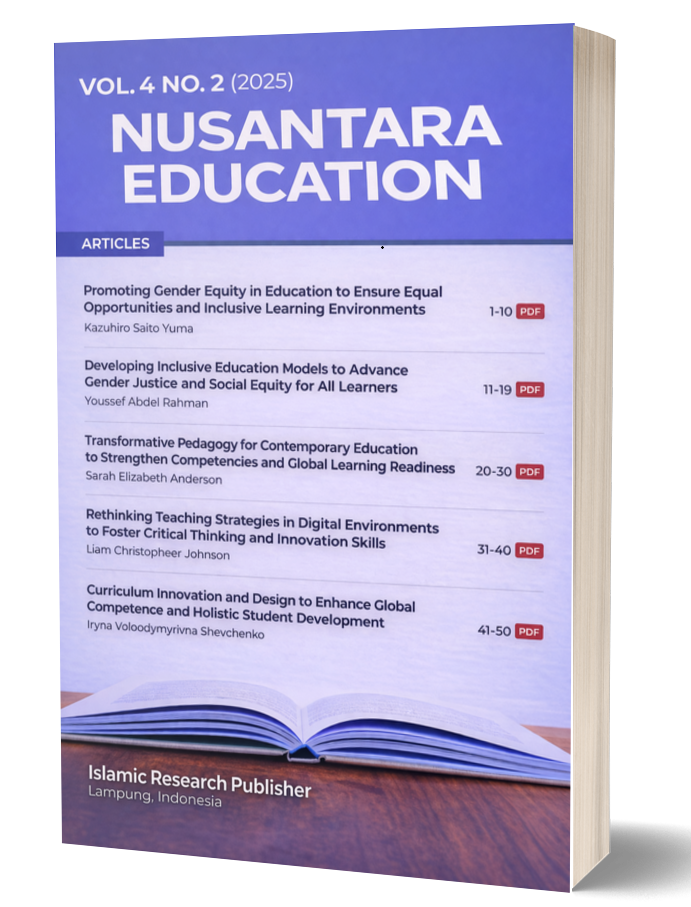
Promoting Gender Equity in Education to Ensure Equal Opportunities and Inclusive Learning Environments
DOI:
https://doi.org/10.66325/nusantaraeducation.v4i2.247Keywords:
Gender equity, inclusive education, learning environments, policy interventions, pedagogical strategies.Abstract
This study explores strategies to promote gender equity in education, aiming to ensure equal opportunities and foster inclusive learning environments. Gender disparities in education remain a persistent challenge, affecting students’ access to resources, participation in classroom activities, and achievement outcomes. Employing a qualitative research design, data were collected through semi-structured interviews, focus group discussions, and document analysis involving educators, policymakers, and students across primary, secondary, and tertiary educational institutions. The analysis reveals that gender biases are embedded not only in curricular content and teaching practices but also in institutional policies and cultural perceptions of gender roles. Targeted interventions, such as gender-sensitive pedagogy, inclusive policy frameworks, and teacher professional development programs, significantly enhance equitable participation and foster supportive learning environments. Furthermore, active engagement from school leadership, parents, and community stakeholders is critical in sustaining long-term gender equity initiatives. This study underscores the importance of integrating policy, pedagogy, and community action to address structural and socio-cultural barriers to equality. The findings contribute to the body of knowledge on inclusive education by providing empirical evidence of effective strategies to reduce gender disparities and promote equitable learning opportunities. In addition, the study offers practical recommendations for educators, policymakers, and researchers, emphasizing the need for continuous monitoring, gender-awareness training, and collaborative efforts to achieve sustainable gender equity in education. Ultimately, this research advocates for systemic, transformative approaches that enable all learners, regardless of gender, to thrive in equitable, inclusive educational settings.
References
Abu Hamour, B., El Khoury, R., & Dababneh, K. (2020). Gender equity in school leadership: Challenges and opportunities in Jordan. Educational Management Administration & Leadership, 48(5), 789–807.
Adams, M., & Smith, J. (2019). Teacher beliefs and gendered student participation in STEM classrooms. Journal of Educational Research, 112(4), 456–472.
Alam, M. (2021). Inclusive curriculum design and gender representation in learning materials. International Journal of Education Policy, 15(2), 113–128.
Allen, A., & Velez, V. (2018). Voices from the classroom: Students’ perceptions of gender bias in secondary schools. Gender and Education, 30(1), 88–104.
Anderson, K., & Mitchell, R. (2022). School policies and gender mainstreaming: Practices and impacts. Policy Futures in Education, 20(3), 345–363.
Ariani, D. (2020). Gender equity in Indonesian education: Patterns and policy responses. Journal of Southeast Asian Education, 8(1), 22–38.
Baker, T., & Jones, P. (2019). Pedagogical strategies for equitable classrooms. Teaching and Teacher Education, 78, 274–285.
Bradshaw, C., & Allen, L. (2017). Analyzing gender patterns in classroom dynamics: A mixed methods approach. Educational Psychology Review, 29(2), 351–370.
Brown, J. (2021). Gender equity lens in curriculum evaluation: A systematic review. Review of Educational Research, 91(3), 387–421.
Carrington, V., & Skelton, C. (2019). Reframing gender and schooling: Theory, research, practice. Routledge.
Chapman, T., & Snyder, J. (2020). Reflective dialogues for inclusive pedagogies: Evidence from secondary schools. Journal of Curriculum Studies, 52(4), 551–570.
Clark, M., & Anderson, D. (2018). Gender equity and student engagement in middle school settings. Middle Grades Review, 4(3), 120–137.
Collins, P. H., & Bilge, S. (2016). Intersectionality. Polity Press.
Creswell, J. W., & Poth, C. N. (2018). Qualitative inquiry and research design: Choosing among five approaches (4th ed.). SAGE.
Daniels, H., & Warmington, P. (2020). Pedagogies of inequality: Rethinking education for social justice. Bloomsbury Academic.
DeVito, L. (2021). Gendered subject choices in upper secondary schools: A longitudinal study. Educational Evaluation and Policy Analysis, 43(1), 71–89.
Elbaz Luwisch, F. (2017). Students’ narratives of gender experiences at school: Challenges and resistance. Gender and Education, 29(5), 607–625.
Freeman, B., & Robbins, S. (2019). Engaging boys and girls in equitable science classrooms. Science Education International, 30(2), 145–162.
Gao, X., & Huang, Y. (2021). Teacher training for gender responsive pedagogy: A cross national perspective. International Journal of Educational Development, 81, 102368.
Gorski, P. (2018). Equity literacy for educators: Definition and application. Educational Leadership, 75(6), 34–39.
Green, J., & Adib, B. (2020). Student voice initiatives: Promoting inclusion and equity. Journal of School Leadership, 30(2), 191–213.
Harris, A., & Jones, M. (2017). Developing inclusive schools: Policy and practice. Educational Management Administration & Leadership, 45(1), 6–25.
Hawkins, R., & Nettleton, B. (2019). The role of mentorship in supporting female students in STEM tracks. Journal of Women and Minorities in Science and Engineering, 25(4), 283–301.
Heffernan, A., & Loxley, A. (2018). Gender and education in the Asia Pacific: Discourse, policy, practice. Springer.
Holland, J., & Renold, E. (2017). Making spaces: Gender, identity and school cultures. Gender and Education, 29(2), 159–174.
Johnson, R., & Onwuegbuzie, A. (2020). Mixed methods research: Frameworks and applications. SAGE Handbook of Qualitative Research in Education.
Kember, D., & McNaught, C. (2019). Enhancing inclusive teaching through reflective practice. Journal of Teaching in Higher Education, 24(7), 848–859.
King, A. (2018). Gender inequity and school leadership in developing contexts. Educational Administration Quarterly, 54(4), 623–650.
Lamb, S., & Rice, S. (2021). Data driven approaches for gender equity in schools. Educational Researcher, 50(4), 260–271.
Lewis, C., & Hays, D. (2022). Digital tools for inclusive pedagogies: Gender considerations. Computers & Education, 171, 104253.
Merriam, S. B., & Tisdell, E. J. (2016). Qualitative research: A guide to design and implementation (4th ed.). Jossey Bass.
Murphy, P., & Ringrose, J. (2020). Gender and sexualities in educational research: New directions. Sociology of Education, 93(3), 211–225.
Noddings, N. (2017). Philosophy of education (4th ed.). Routledge.
Organisation for Economic Co operation and Development. (2018). Education at a glance 2018: OECD indicators. OECD Publishing.
Rahayu, S., & Prasetyo, A. (2019). Gender representation in Indonesian school curriculum: Analysis and implications. Journal of Indonesian Education and Teaching, 7(2), 50–66.
Risman, B. J. (2020). Gender as a social structure (2nd ed.). Routledge.
Schein, E. H. (2018). Organizational culture and leadership (5th ed.). Wiley.
Suryani, A. (2020). Gender disparities in Indonesian schools: Student participation and teacher perceptions. Indonesian Journal of Educational Studies, 12(1), 45–60.
UNESCO. (2021). Global education monitoring report 2021/2: Gender report — A new generation. UNESCO Publishing.
World Bank. (2019). World development report 2019: The changing nature of work. World Bank Publications.
Yin, R. K. (2018). Case study research and applications: Design and methods (6th ed.). SAGE.
Young, M. D., & Laible, R. (2020). Promoting equitable learning environments: Theory and practice. Educational Review, 72(5), 555–573.
Zubrzycki, J., & Habaradas, R. (2017). Inclusive language and gender equity in educational leadership. Journal of Education Policy, 32(6), 734–752.
Downloads
Published
Issue
Section
License
Copyright (c) 2025 Kazuhiro Saito Yuma

This work is licensed under a Creative Commons Attribution-ShareAlike 4.0 International License.