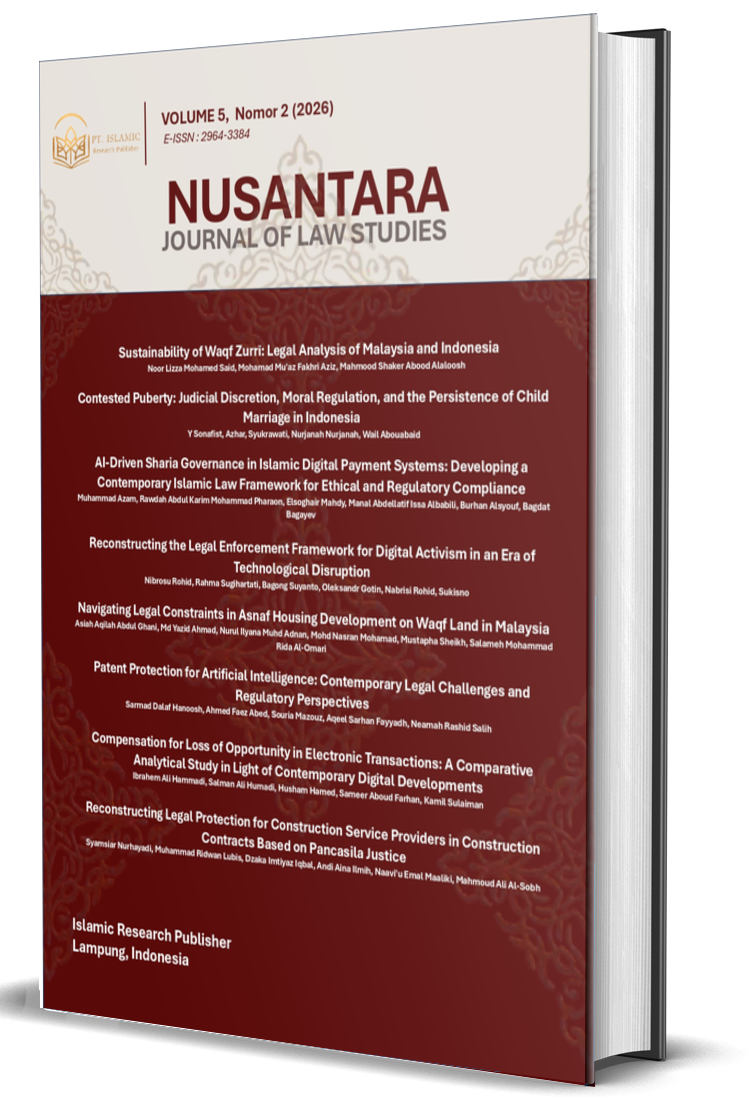
AI-Driven Sharia Governance in Islamic Digital Payment Systems: Developing a Contemporary Islamic Law Framework for Ethical and Regulatory Compliance
DOI:
https://doi.org/10.66325/nusantaralaw.v5i2.339Keywords:
Artificial Intelligence (AI); Explainable Artificial Intelligence (XAI); Islamic Digital Payment Systems; Maqasid al-Shariah; Sharia Governance.Abstract
The rapid advancement of artificial intelligence (AI) and digital financial technologies has transformed the operational landscape of Islamic financial institutions, creating both new opportunities and significant challenges for Sharia governance. As Islamic digital payment systems increasingly rely on AI-driven tools for transaction monitoring, fraud detection, risk assessment, and compliance verification, important questions arise regarding their compatibility with the principles and objectives of Islamic law. This study examines the role of AI in strengthening Sharia governance within Islamic digital payment ecosystems and evaluates its effectiveness in identifying prohibited elements, including riba, gharar, and other forms of financial misconduct. Using a doctrinal legal research methodology supported by comparative analysis and qualitative content analysis, the study examines primary and secondary sources of Islamic law, including the Qur'an, Sunnah, classical fiqh literature, contemporary Sharia governance standards, and regulatory frameworks from selected Islamic finance jurisdictions. The findings suggest that AI can substantially enhance Sharia compliance through real-time monitoring, predictive analytics, and automated auditing mechanisms. However, concerns related to algorithmic transparency, explainability, accountability, and the inherent limitations of AI in performing ijtihad and issuing fatwa-based judgments prevent it from replacing human scholarly authority in Sharia decision-making. The study argues that AI should function as a decision-support tool rather than an autonomous Sharia decision-maker. To address the governance challenges associated with AI implementation, the article proposes a contemporary Islamic law framework built upon five interconnected pillars: Human-Centered Sharia Supervision, Explainable Artificial Intelligence (XAI), Maqasid al-Shariah Compliance, Continuous Sharia Auditing, and Regulatory Accountability. This framework aims to harmonize technological innovation with the ethical, legal, and jurisprudential foundations of Islamic law while ensuring responsible and trustworthy AI deployment in Islamic finance. The study contributes to the growing literature on Islamic FinTech and AI governance by offering a normative framework for regulating AI applications in Islamic digital payment systems.
Downloads
References
Ab Razak, Muhammad Ilyas, and Nur Akma Mohd Dali. “The Key Challenges of Islamic Fintech Implementation in Malaysia.” Journal of Central Banking Law and Institutions 5, no. 1 (2026): 153–174. https://doi.org/10.21098/jcli.v5i1.270.
Abu Bakar, Aimi Aisyah, Norhayati Rafida Abdul Rahim, and Muhammad Nizam Awang. “Communicating Shariah and Regulatory Frames for AI-Powered Halal Auditing.” Al-i’lam - Journal of Contemporary Islamic Communication and Media 5, no. 1 (2025). https://doi.org/10.33102/jcicom.vol5no1.138.
Aishat Abdul-Qadir Zubair, Kamaldeen Salman, and Abdulrazaak Olufemi Zakariyyah. “Existing Legal & Regulatory Framework For Sovereign Sukuk In Nigeria.” Global Islamic Research Journal 2, no. 1 (2026): 36–73. https://doi.org/10.65960/girj.2.1.2026.8.
Al-Fatih, Sholahuddin, Putri Shafarina Thahir, Nafik Muthohirin, and Norhasliza Ghapa. “Artificial Intelligence in Indonesia’s Financial Sector: Regulatory and Islamic Law Perspectives.” Justicia Islamica 22, no. 2 (2025): 303–326. https://doi.org/10.21154/justicia.v22i2.10479.
Alnamlah, Abdullah, M. Kabir Hassan, Asem Alhomaidi, and Edib Smolo. “A New Model for Screening Shariah-Compliant Firms.” Borsa Istanbul Review 22 (December 2022): S10–23. https://doi.org/10.1016/j.bir.2022.10.011.
Amrullah, Amrullah, and Richard. “Islamic Legal Reform In Facing The Challenges of The Digital Economy And The Islamic Financial System.” Dialog Legal: Jurnal Syariah, Jurisprudensi Dan Tata Negara 2, no. 1 (2025): 97–106. https://doi.org/10.64367/dialoglegal.v2i1.135.
Azam, Muhammad, Abdullah Abdul-Majeed Hamdoun, Eid Abed Alhaleem Maslat Harahsheh, Anis Mashdurohatun, and Hamonangan Parsaulian Sidauruk. “Religious Diversity in the Digital Economy: Interfaith Legal Pathways to Harmonize Sharia, Christian Ethics, and International Law.” Contemporary Issues on Interfaith Law and Society 4, no. 2 (2025): 207–264. https://doi.org/10.15294/ciils.v4i2.33011.
Azam, Muhammad, Saleh Hashem Al-Farjani, Anis Mashdurohatun, Atta Elsonbaty, and Mohammed Abdullah Salman. “E-Contract Withdrawal Rights in E-Commerce: A Comparative Analysis of the Egyptian Consumer Protection Law and Islamic Jurisprudential Perspectives.” Ulul Albab: Jurnal Studi Dan Penelitian Hukum Islam 8, no. 2 (2025): 215. https://doi.org/10.30659/jua.v8i2.44766.
Azwar, Azwar, Abur Hamdi Usman, and Mohd Farid Ravi Abdullah. “Artificial Intelligence and Islamic Finance: A Scopus-Based Literature Mapping through a PRISMA Protocol.” Journal of Islamic Law on Digital Economy and Business, August 23, 2025, 65–83. https://doi.org/10.20885/JILDEB.vol1.iss1.art5.
Bagus Khusfi Satyo, S.H., M.Kn. and Bagus Agung Yuda Prasetyo, S.H., M.Kn. “Artificial Intelligence and the Future of Human Rights: Legal Accountability for Algorithmic Decision-Making in Democratic Societies.” International Journal of Law and Social Sciences 2, no. 1 (2026): 54–74. https://doi.org/10.65960/ijlss.2.1.2026.12.
Baharuddin, Madiha. “Bridging Islamic Technological Heritage with Modern Innovations: Ethical and Practical Perspectives.” Journal of Al-Tamaddun 21, no. 1 (2026): 71–94. https://doi.org/10.22452/JAT.vol21no1.5.
Dahiyat, Emad Abdel Rahim. “A Legal Framework for Online Commercial Arbitration in UAE: New Fabric but Old Style!” Information & Communications Technology Law 26, no. 3 (2017): 272–292. https://doi.org/10.1080/13600834.2017.1374055.
Faheem Ullah Al Azhari and Sajid Iqbal Al Azhari. “Contemporary Challenges in Harmonizing Sharia, National Legal Systems, and International Law in a Rapidly Changing World.” International Journal of Law and Social Sciences 1, no. 1 (2025): 130–150. https://doi.org/10.65960/ijlss.1.1.2025.4.
Faheem Ullah Al Azhari, Syed Hassan Mahmood Shah, Sajid Iqbal Al Azhari, et al. “The Role of Islamic Economic Principles in Family Law: A Study on Inheritance and Property Rights within the Context of Child Protection.” Global Islamic Research Journal 1, no. 1 (2025): 59–76. https://doi.org/10.65960/girj.1.1.2025.2.
Fidhayanti, Dwi, Mohd Shahid Mohd Noh, Ramadhita Ramadhita, and Syabbul Bachri. “Exploring The Legal Landscape of Islamic Fintech in Indonesia: A Comprehensive Analysis of Policies and Regulations.” F1000Research 13 (June 2024): 21. https://doi.org/10.12688/f1000research.143476.2.
Habib, Zainal. “Ethics of Artificial Intelligence in Maqāṣid Al-Sharīa’s Perspective.” KARSA Journal of Social and Islamic Culture 33, no. 1 (2025): 105–134. https://ejournal.uinmadura.ac.id/index.php/karsa/article/view/19617.
Hamadou, Issa, Aimatul Yumna, Hawaou Hamadou, and Mamadou Salieu Jallow. “Unleashing the Power of Artificial Intelligence in Islamic Banking: A Case Study of Bank Syariah Indonesia (BSI).” Modern Finance 2, no. 1 (2024): 131–144. https://doi.org/10.61351/mf.v2i1.116.
Islam, Shareeful, Bilal Sardar, Eleni Maria Kalogeraki, Kostas Lampropoulos, and Spyridon Papastergiou. “Hybrid AI-Based Dynamic Risk Assessment Framework with Explainable AI Practices for Composite Product Cybersecurity Certification.” International Journal of Information Security 25, no. 2 (2026): 51. https://doi.org/10.1007/s10207-026-01218-0.
Kharisma, Dona Budi, Jamal Wiwoho, and Ifan Arsyad. “AI Meets Shariah: Ensuring Robo-Advisors for Compliance in Islamic Mutual Funds.” Journal of Islamic Accounting and Business Research, November 4, 2025, 1–14. https://doi.org/10.1108/JIABR-10-2024-0388.
Latifah, Leti. “Regulatory and Ethical Duality in Indonesia’s Fintech P2P Lending: Conventional vs. Sharia Models from an Islamic Economics Perspective.” Al-Muhasib: Journal of Islamic Accounting and Finance 5, no. 1 (2025): 74–98. https://doi.org/10.30762/al-muhasib.v5i1.2344.
Mohamed, Hanan Amin, and Toshitsugu Otake. “The Role of Islamic FinTech in Digital Financial Inclusion and Sustainable Development Post Covid-19: Cross-Country Analysis.” International Journal of Islamic and Middle Eastern Finance and Management 18, no. 3 (2025): 649–671. https://doi.org/10.1108/IMEFM-02-2024-0100.
Muhammad Azam, Anis Mashdurohatun, Angga Nugraha Firmansyah, Muhammad Dias Saktiawan, and King on Putra Jaya. “Harmonizing Contemporary International Commercial Law with Sharia-Based National Legal Systems: A Comparative Study of Pakistan, Turkey, Indonesia, Malaysia, and Saudi Arabia.” MILRev: Metro Islamic Law Review 4, no. 2 (2025): 1074–1096. https://doi.org/10.32332/milrev.v4i2.11334.
Mukthar, K. P. Jaheer, Neerupa Chauhan, Mujeeb Saif Mohsen Al-Absy, R. Naveen Kumar, Nidhi Raj Gupta, and S. Gokilavani. “Research Dynamics in AI and Fintech: A Bibliometric Investigation Using R.” Discover Internet of Things 5, no. 1 (2025): 19. https://doi.org/10.1007/s43926-025-00111-x.
Muryanto, Yudho Taruno. “The Urgency of Sharia Compliance Regulations for Islamic Fintechs: A Comparative Study of Indonesia, Malaysia and the United Kingdom.” Journal of Financial Crime 30, no. 5 (2023): 1264–1278. https://doi.org/10.1108/JFC-05-2022-0099.
Saleh Hashem Al-Farjani, Tanveer Ahmad, and Dr Hafiz Ahmed Saeed Rana. “Digital Innovation, Legal Reform, and Social Justice: Interdisciplinary Approaches to Law, Technology, and Human Rights.” International Journal of Law and Social Sciences 1, no. 1 (2025): 91–129. https://doi.org/10.65960/ijlss.1.1.2025.5.
Salem, Mohammed R. M. “Digital Financial Intuition and AI-Driven Marketing: Enhancing Perceived Fairness to Improve Customer Retention in Malaysian Islamic Banks.” Interdisciplinary Journal of Management Studies (IR), no. Online First (October 2025). https://doi.org/10.22059/ijms.2025.397480.677731.
Shalhoob, H. The Role of AI in Enhancing Shariah Compliance: Efficiency and Transparency in Islamic Finance. n.d. https://doi.org/10.24294/jipd11239.
Ünvan, Yüksel Akay, and Hala Alsokhni. “The Evolution of Artificial Intelligence Research in Finance: A Bibliometric Analysis of Trends and Future Directions.” Finance Research Open 2, no. 1 (2026): 100083. https://doi.org/10.1016/j.finr.2025.100083.
Wurth, Bernd, Erik Stam, and Ben Spigel. “Entrepreneurial Ecosystem Mechanisms.” Foundations and Trends® in Entrepreneurship 19, no. 3 (2023): 224–339. https://doi.org/10.1561/0300000089.
Zafar, Muhammad Bilal, and Hassnian Ali. “Shariah Governance Standard on Generative AI for Islamic Financial Institutions.” Preprint, SSRN, 2025. https://doi.org/10.2139/ssrn.5143165.
Zakaria, Nadisah, Ainin Sulaiman, Foo Siong Min, and Ali Feizollah. “Machine Learning In the Financial Industry: A Bibliometric Approach to Evidencing Applications.” Cogent Social Sciences 9, no. 2 (2023): 2276609. https://doi.org/10.1080/23311886.2023.2276609.
Downloads
Published
Issue
Section
License
Copyright (c) 2026 Muhammad Azam, Rawdah Abdul Karim Mohammad Pharaon, Elsoghair Mahdy, Manal Abdellatif Issa Albabili, Burhan Alsyouf, Bagdat Bagayev

This work is licensed under a Creative Commons Attribution-ShareAlike 4.0 International License.