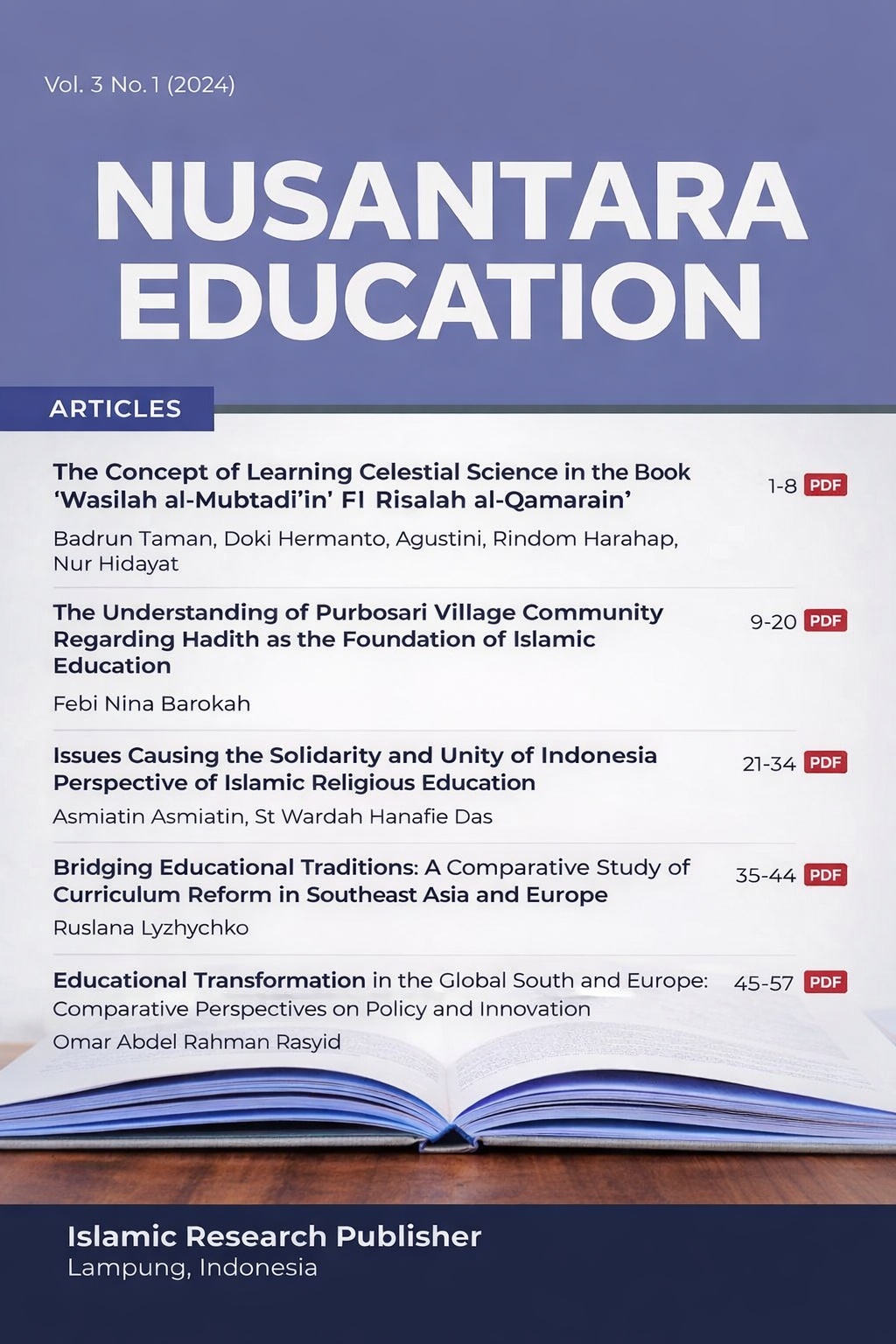
Educational Transformation in the Global South and Europe: Comparative Perspectives on Policy and Innovation
DOI:
https://doi.org/10.66325/nusantaraeducation.v3i1.238Keywords:
Comparative Education; Educational Innovation; Educational Policy; Global South; Higher Education Reform.Abstract
Educational transformation has become a central agenda in many countries as they respond to rapid technological change, globalization, and shifting socio-economic demands. However, the trajectory and policy orientation of educational reform often differ significantly between regions. This study aims to analyze and compare the dynamics of educational transformation in the Global South and Europe, with a particular focus on policy frameworks and innovation strategies that shape contemporary education systems. By examining these comparative perspectives, the research seeks to identify patterns, challenges, and opportunities that influence the direction of educational reform across different socio-political contexts. This study employs a qualitative comparative research design using a systematic literature review approach. Academic articles, policy reports, and scholarly publications indexed in major international databases were analyzed to explore key themes related to educational policy reform, institutional innovation, governance models, and the integration of technology in education. The analysis was conducted through thematic coding and comparative synthesis to identify similarities and divergences between educational transformation strategies in the Global South and European countries. The findings reveal that educational transformation in the Global South is largely driven by efforts to expand access, improve institutional capacity, and address structural inequalities, often supported by international cooperation and development-oriented policies. In contrast, European education systems tend to emphasize innovation-driven reforms, including digital learning ecosystems, research-based policy development, and collaborative governance among educational stakeholders. Despite these differences, both regions increasingly prioritize curriculum modernization, digital transformation, and inclusive education as key components of educational reform. This study contributes to the scholarly discourse on global education policy by offering a comparative framework that highlights how contextual factors—such as governance structures, economic capacity, and socio-cultural dynamics—shape educational transformation. The findings provide valuable insights for policymakers, educators, and researchers seeking to develop adaptive and context-sensitive strategies for sustainable educational innovation in diverse global settings.
References
Altbach, P. G., & Salmi, J. (2011). The road to academic excellence: The making of world-class research universities. World Bank.
Audretsch, D. B., Cunningham, J. A., Kuratko, D. F., Lehmann, E. E., & Menter, M. (2019). Entrepreneurial ecosystems: Economic, technological, and societal impacts. Journal of Technology Transfer, 44(2), 313–325.
Barnett, R. (2011). The marketised university: Defending the indefensible. Higher Education Quarterly, 65(1), 41–56.
Bitar, D., & Davidovich, N. (2023). Digital transformation in higher education: Pedagogical innovation and institutional challenges. Education and Information Technologies, 29(2), 1467–1484. https://doi.org/10.1007/s10639-023-12041-7
Cloete, N., Maassen, P., & Bailey, T. (2015). Knowledge production and higher education transformation in Africa. Higher Education, 70(1), 1–18.
de Wit, H., Hunter, F., Howard, L., & Egron-Polak, E. (2015). Internationalisation of higher education. European Parliament Study.
Etzkowitz, H., & Leydesdorff, L. (2000). The dynamics of innovation: From national systems to a triple helix of university–industry–government relations. Research Policy, 29(2), 109–123.
Hoareau, C., Ritzen, J., & Marconi, G. (2013). Higher education and economic innovation: A comparison of European countries. Applied Economics, 45(33), 4681–4690. https://doi.org/10.1080/00036846.2013.770124
Leal Filho, W., et al. (2019). Sustainable development and higher education: Reviewing the role of universities. Journal of Cleaner Production, 226, 567–577.
Marginson, S. (2016). The worldwide trend to higher participation in higher education: Dynamics of social stratification in inclusive systems. Higher Education, 72(4), 413–434. https://doi.org/10.1007/s10734-016-0016-x
Mok, K. H. (2016). Massification of higher education, graduate employment and social mobility in the Greater China region. British Journal of Sociology of Education, 37(1), 51–71. https://doi.org/10.1080/01425692.2015.1111751
Nguyen, Q. T. (2020). The impact of digital transformation on higher education institutions in developing countries. International Journal of Educational Technology in Higher Education, 17(1), 1–19. https://doi.org/10.1186/s41239-020-00194-7
Nguyen, Q. T. (2020). The impact of digital transformation on higher education institutions in developing countries. International Journal of Educational Technology in Higher Education, 17(1), 1–19. https://doi.org/10.1186/s41239-020-00194-7
OECD. (2019). Education policy outlook 2019: Working together to help students achieve their potential. OECD Publishing.
Peters, M. A., & Besley, T. (2018). Global education policy and the politics of knowledge. Educational Philosophy and Theory, 50(6–7), 561–573. https://doi.org/10.1080/00131857.2017.1343114
Salmi, J. (2017). Tertiary education and the sustainable development goals: In search of a viable funding model. Higher Education Policy, 30(1), 1–18. https://doi.org/10.1057/s41307-016-0035-8
Tang, Y., Zhang, L., & Wu, S. (2023). Digital transformation and innovation ecosystems in higher education institutions. Technological Forecasting and Social Change, 203, 123456. https://doi.org/10.1016/j.techfore.2023.123456
Tang, Y., Zhang, L., & Wu, S. (2023). Digital transformation and innovation ecosystems in higher education institutions. Technological Forecasting and Social Change, 203, 123456.
Teixeira, P. N., & Dill, D. D. (2011). Public vices, private virtues? Assessing the effects of marketization in higher education. Higher Education Management and Policy, 23(1), 1–18.
Teixeira, P. N., & Dill, D. D. (2011). Public vices, private virtues? Assessing the effects of marketization in higher education. Higher Education Management and Policy, 23(1), 1–18.
Trow, M. (2010). Twentieth-century higher education: Elite to mass to universal. Higher Education Policy, 23(2), 243–280. https://doi.org/10.1057/hep.2010.9
Unterhalter, E. (2019). The many meanings of quality education. International Journal of Educational Development, 68, 1–8.
Veugelers, R. (2017). The challenge of innovation in Europe. Intereconomics, 52(4), 195–198. https://doi.org/10.1007/s10272-017-0678-3
World Bank. (2020). The changing nature of work and skills development in higher education. World Bank Publications.
Downloads
Published
Issue
Section
License
Copyright (c) 2024 Omar Abdel Rahman Rasyid

This work is licensed under a Creative Commons Attribution-ShareAlike 4.0 International License.