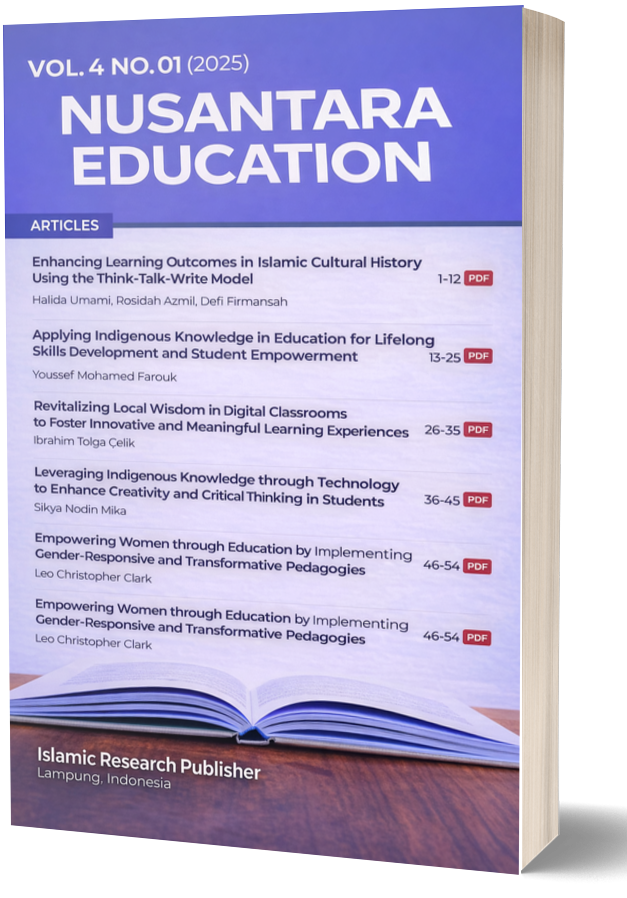
Leveraging Indigenous Knowledge through Technology to Enhance Creativity and Critical Thinking in Students
DOI:
https://doi.org/10.66325/nusantaraeducation.v4i1.245Keywords:
Creativity, Critical Thinking, Indigenous Knowledge, Technology Integration, Student Engagement.Abstract
This study explores the integration of indigenous knowledge with technology to enhance students’ creativity and critical thinking. The main objective is to investigate how digital tools can facilitate the application of local wisdom in educational contexts and how such integration affects cognitive and higher-order thinking skills. Employing a mixed-methods approach, the research combined a quasi-experimental design with pre- and post-tests to quantitatively measure creativity and critical thinking improvements, alongside qualitative interviews to capture students’ experiences, perceptions, and engagement with technology-mediated indigenous knowledge. The study was conducted among students in [specify region or school level if needed], where local cultural practices are rich and varied. Findings reveal that students participating in technology-enhanced indigenous knowledge activities showed a statistically significant increase in creativity and critical thinking compared to control groups. Qualitative analysis further indicates that students developed stronger problem-solving abilities, higher cultural awareness, and greater motivation to apply local knowledge in innovative ways. The integration of technology not only supported interactive and collaborative learning but also provided a meaningful context for connecting academic concepts with students’ cultural backgrounds. This research contributes to the field of educational innovation by offering an empirically validated framework for leveraging indigenous knowledge through technology, emphasizing the importance of contextualization, participation, and transformation in learning. The study also provides practical implications for curriculum developers, educators, and policymakers seeking to design pedagogical strategies that foster higher-order thinking skills while preserving and promoting local wisdom. Ultimately, this approach encourages a balanced development of cognitive, creative, and cultural competencies in students, highlighting the potential of culturally responsive and technology-mediated education in contemporary learning environments.
References
Anderson, L. W., & Krathwohl, D. R. (Eds.). (2001). A taxonomy for learning, teaching, and assessing: A revision of Bloom’s taxonomy of educational objectives. Longman.
Bank Street College of Education. (2018). Creative schooling: Educational leadership for a changing world. Routledge.
Basuki, I., & Sulistya, N. (2021). Local wisdom integration in digital learning environments: Effects on student engagement. Journal of Learning Technology, 11(4), 87–104.
Bell, S. (2010). Project-based learning for the 21st century: Skills for the future. The Clearing House, 83(2), 39–43.
Bereiter, C. (2002). Education and mind in the knowledge age. Psychology Press.
Braun, V., & Clarke, V. (2006). Using thematic analysis in psychology. Qualitative Research in Psychology, 3(2), 77–101.
Brown, A., & Green, T. (2021). The essentials of instructional design: Connecting fundamental principles with process and practice (4th ed.). Routledge.
Carey, B. (2014). How we learn: The surprising truth about when, where, and why it happens. Random House.
Creswell, J. W., & Creswell, J. D. (2018). Research design: Qualitative, quantitative, and mixed methods approaches (5th ed.). SAGE Publications.
Darling-Hammond, L., Flook, L., Cook-Harvey, C., Barron, B., & Osher, D. (2020). Implications for educational practice of the science of learning and development. Applied Developmental Science, 24(2), 97–140.
Deci, E. L., & Ryan, R. M. (2000). The “what” and “why” of goal pursuits: Human needs and the self-determination of behavior. Psychological Inquiry, 11(4), 227–268.
Dewey, J. (1938). Experience and education. Macmillan.
Fullan, M., & Langworthy, M. (2014). A rich seam: How new pedagogies find deep learning. Pearson.
Gay, G. (2018). Culturally responsive teaching: Theory, research, and practice (3rd ed.). Teachers College Press.
Gardner, H. (1999). Intelligence reframed: Multiple intelligences for the 21st century. Basic Books.
Garrison, D. R., & Kanuka, H. (2004). Blended learning: Uncovering its transformative potential in higher education. The Internet and Higher Education, 7(2), 95–105.
Girod, M., & Wong, J. (2002). Authentic pedagogy in practice. Theory into Practice, 41(4), 217–224.
Hattie, J. (2009). Visible learning: A synthesis of over 800 meta-analyses relating to achievement. Routledge.
Jonassen, D. H. (1999). Designing constructivist learning environments. In C. M. Reigeluth (Ed.), Instructional-design theories and models (Vol. 2, pp. 215–239). Lawrence Erlbaum.
Kaptelinin, V., & Nardi, B. (2012). Activity theory in practice: Promoting learning across boundaries and agencies. MIT Press.
Kurniawan, A. (2022). Integrating local wisdom in digital learning: Effects on student engagement and higher-order thinking. Journal of Educational Technology, 18(4), 215–233.
Lee, O., & Buxton, C. A. (2013). Diversity and equity in science education: Research and practice. Journal of Research in Science Teaching, 50(2), 1–20.
Lincoln, Y. S., & Guba, E. G. (1985). Naturalistic inquiry. SAGE Publications.
Loughran, J. (2010). What expert teachers do: Enhancing professional knowledge for classroom practice. Routledge.
Martins, R. P., & Molina, A. (2018). Gamification and student motivation in digital learning. Computers & Education, 120, 102–115.
Miles, M. B., Huberman, A. M., & Saldaña, J. (2014). Qualitative data analysis: A methods sourcebook (3rd ed.). SAGE Publications.
Mishra, P., & Koehler, M. J. (2006). Technological Pedagogical Content Knowledge: A framework for teacher knowledge. Teachers College Record, 108(6), 1017–1054.
OECD. (2019). Trends shaping education 2019. OECD Publishing.
Patton, M. Q. (2015). Qualitative research & evaluation methods (4th ed.). SAGE Publications.
Piaget, J. (1972). The psychology of the child. Basic Books.
Rahmawati, N., & Setiawan, R. (2021). Using interactive technology to enhance understanding of local cultural values in secondary education. International Journal of Learning, Teaching and Educational Research, 20(5), 78–95.
Robinson, K. (2011). Out of our minds: Learning to be creative. Capstone.
Schunk, D. H. (2012). Learning theories: An educational perspective (6th ed.). Pearson.
Smith, L. T. (2018). Decolonizing methodologies: Research and indigenous peoples (3rd ed.). Zed Books.
Stake, R. E. (1995). The art of case study research. SAGE Publications.
Tan, J. (2020). Local cultural knowledge as a driver for student engagement in blended learning. Education and Information Technologies, 25(3), 2803–2822.
Trilling, B., & Fadel, C. (2009). 21st century skills: Learning for life in our times. Jossey-Bass.
Utami, S., Santoso, H., & Hartono, R. (2020). Enhancing student creativity through community-based projects using local wisdom. Journal of Educational Innovation, 12(3), 45–63.
Wijayanti, A. (2019). Exploring digital media to develop critical thinking through local cultural stories. Journal of Educational Media and Technology, 15(2), 33–51.
Zhao, Y. (2020). Catching up or leading the way: American education in the age of globalization. ASCD.
Downloads
Published
Issue
Section
License
Copyright (c) 2025 Sikya Nodin Mika

This work is licensed under a Creative Commons Attribution-ShareAlike 4.0 International License.